The Hybrid Sales Development Playbook: Scaling Pipeline with AI-Enabled SDR Teams
The Hybrid Sales Development Playbook: Scaling Pipeline with AI-Enabled SDR Teams
For the last twenty years, the formula for scaling a B2B sales organization was remarkably simple: increase the headcount. If you wanted more pipeline, you hired more Sales Development Representatives (SDRs). If you wanted to enter a new market, you built a new localized team. This linear relationship between hiring and revenue was the bedrock of SaaS growth.
In 2026, that bedrock has fractured.
The cost of acquiring a customer (CAC) has skyrocketed while the effectiveness of legacy outbound tactics has plummeted. Buyers are more shielded than ever before, using their own AI agents to filter noise and block unsolicited outreach. On the other side, the "spray and pray" methodology of the early 2010s is officially dead. Companies can no longer afford to burn through talent in a high-turnover SDR role just to keep their calendars full.
Instead, the most successful revenue organizations are moving toward a Hybrid Sales Development Model.
This playbook is not about replacing your humans with robots. It is about a strategic redistribution of labor. It is about an architecture where AI Agents handle the repetitive, data-intensive, and high-volume tasks, while your human experts focus exclusively on what they do best: building trust, navigating complex stakeholder environments, and closing revenue.
The Structural Failure of the Legacy SDR Model
To understand why the hybrid model is necessary, we must first acknowledge why the current system is failing. The legacy SDR role is essentially a "human-powered data processor." We ask junior employees to spend forty hours a week scraping LinkedIn, cleaning CRM data, writing personalized snippets, and following up on dead-end leads.
This creates several systemic points of failure:
- The Ramp Time Deficit: It takes an average of three to four months to fully train a human SDR. During this time, the company is absorbing a significant financial loss. Learn more about this in our deep dive on AI SDR vs Human SDR ROI.
- Inconsistent Quality: Humans have off-days. They get tired. They forget to follow up. They skip the deep research on a Friday afternoon. In sales, consistency is the difference between a booked meeting and a lost opportunity.
- The Burnout Cycle: The repetitive nature of outbound lead generation leads to an average SDR tenure of barely fourteen months. Just as a rep becomes an expert in your product, they either leave the company or move to an Account Executive role, forcing you to restart the expensive hiring process.
The AI Sales Agent represents the first true technological solution to these human constraints. By integrating these agents into your core workflow, you create a "Floor of Productivity" that never wavers.
Defining the Hybrid Roles: Who Does What?
A high-performance hybrid team is built on a clear division of responsibilities. You must stop thinking of AI as a tool and start thinking of it as a teammate with a specific job description.
The AI Sales Agent (The Researcher and Opener)
The AI Agent is your front-line infantry. It operates at a scale that is mathematically impossible for a human. Its job description includes:
- Continuous Intent Monitoring: Scanning your website, social feeds, and third-party intent data platforms to identify companies currently in a "buying window."
- Deep Prospect Research: Analyzing the latest corporate earning reports, LinkedIn activity, and news articles for every individual prospect to find a legitimate "reason for outreach."
- High-Volume Outreach: Deploying hundreds of hyper-personalized emails and LinkedIn messages daily, ensuring that every touchpoint feels like it was written by a human expert.
- Initial Lead Qualification: Engaging in two-way conversations to answer basic friction questions (pricing, integrations, feature sets) and ensuring the prospect meets your Ideal Customer Profile (ICP). If you are looking for a complete definition of this role, see our B2B AI SDR Complete Guide.
The Human Revenue Professional (The Consultant and Closer)
Once the AI Agent has sparked interest and verified the lead, the human steps in. The human role is elevated from "outreach worker" to "strategic consultant." Their responsibilities include:
- Complex Objection Handling: Navigating the subtle, political, or emotional reasons why a company might be hesitant to buy.
- Multi-Stakeholder Navigation: Identifying and building relationships with the "Hidden Influencers" in an organization beyond the primary contact.
- Creative Deal Architecting: Designing custom solutions, pricing packages, and implementation plans that an AI cannot visualize.
- Relationship Continuity: Being the human face of the brand that builds long-term trust and loyalty.
 SaaS Visualization Hybrid
The Hybrid Workflow: A Four-Step Execution Framework
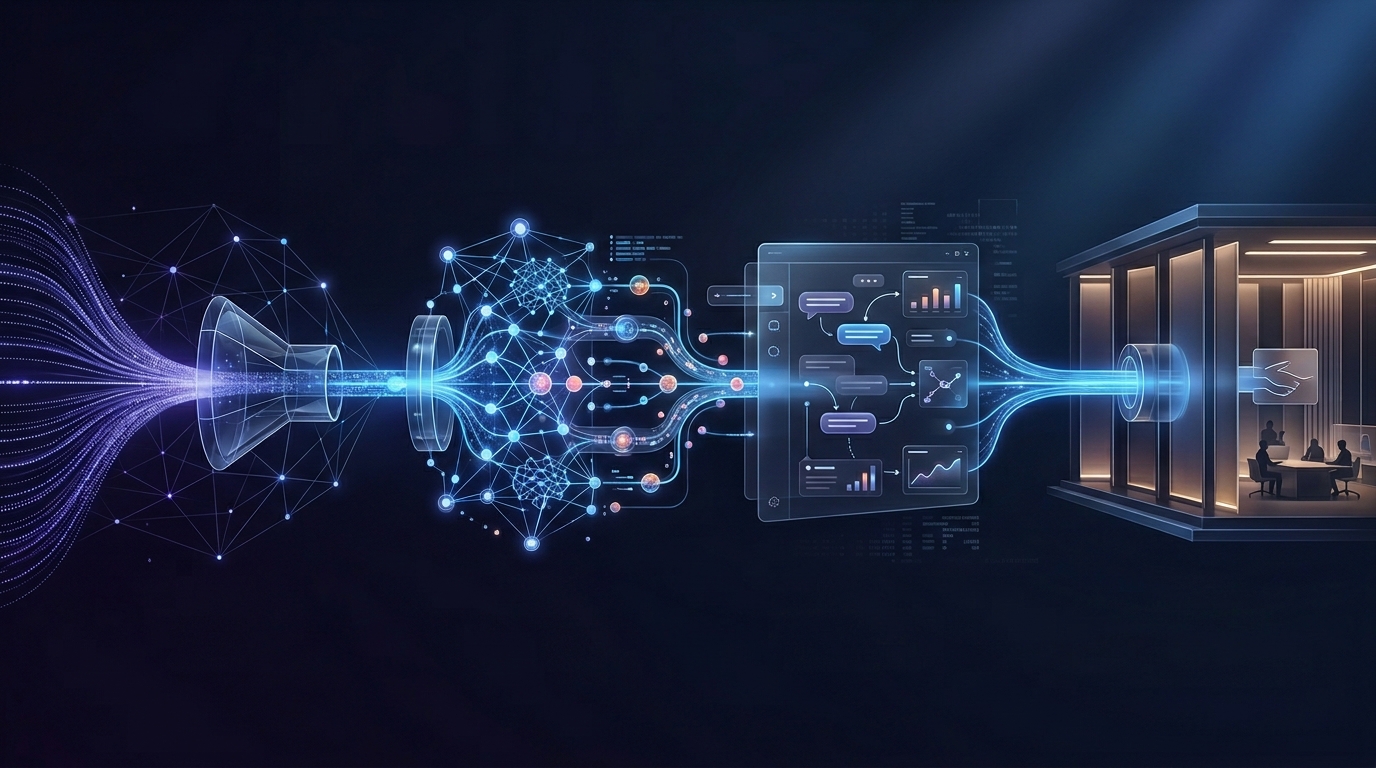
The magic of the hybrid model happens in the handoff. For this to work at scale, you need a documented, repeatable workflow that connects your AI agents directly to your human sales floor.
Step 1: The Intent Signal and Data Enrichment
The workflow begins with a trigger. This could be a prospect downloading a whitepaper, visiting your pricing page three times in a week, or a news event about your prospect's company. The AI Agent immediately "claims" the lead. It enriches the contact record with the latest firmographic data and finds the specific social triggers that will make the outreach relevant.
Step 2: Personalized, Autonomous Outreach
The AI Agent initiates the conversation. Unlike legacy "automated sequences" which are just static templates, the Agentic AI drafts its messages in real-time based on the data it found in Step 1. It operates across multiple channels (Email, LinkedIn, and even SMS) to find the prospect where they are most active.
Step 3: Qualification and Conversational Nurture
When the prospect replies, the AI Agent does not just notify a human. It continues the conversation. It answers the "Do you integrate with X?" and "Can I see a case study for industry Y?" questions instantly. This "Speed to Lead" is a critical competitive advantage. Research shows that responding to a lead in under five minutes increases the likelihood of conversion by over nine times.
Step 4: The Warm Handoff
Once the AI Agent detects "High Intent" (e.g., the prospect asks for a demo or says "Lets chat next Tuesday"), it uses your scheduling tool to book a meeting directly on the human rep's calendar. The human rep wakes up every morning with a calendar full of meetings where the "pre-work" has already been done. They have a full transcript of the AI's conversation, giving them the context they need to walk into the call and be effective immediately.
The "Human-in-the-Loop" (HITL) Guardrails
For enterprise sales, you cannot simply let an AI run completely wild. You need guardrails. The most sophisticated hybrid teams use a "Human-in-the-Loop" system for their most valuable accounts.
If a lead is from a "Tier 1" target account (e.g., a Fortune 500 company), the AI Agent can be configured to "Draft but not Send." The AI does all the research and writes the perfect message, but it puts it into a review queue for the human SDR or AE. The human spends thirty seconds reviewing, making one or two tiny tweaks, and clicking send. This combines the speed of AI with the strategic oversight of your best humans.
This approach ensures that your highest-value prospects receive a "Diamond Level" experience while your high-volume leads receive a "Gold Level" automated experience. You can find more strategies for this in our guide on AI Lead Qualification in 2026.
 Sales System Integrated
Integrating Your Hybrid Team with HubSpot and Salesforce
Data hygiene is the silent killer of sales productivity. Human reps hate updating the CRM, which leads to "dirty data" and missed opportunities. AI Agents, by their nature, are perfect at data entry.
When you connect an AI Agent to your CRM, every interaction is logged automatically.
- Status Changes: The AI moves leads from "New" to "Contacting" to "SQL" in real-time.
- Data Enrichment: Every time the AI finds a new phone number or job title, it updates the record.
- Workflow Triggers: You can set up automation in HubSpot or Salesforce that triggers specific marketing emails or human tasks based on the "Sentiments" detected by the AI Agent.
This level of integration turns your CRM from a "System of Record" into a "System of Action."
Measuring Success: The New Metrics of AI-Enabled Sales
You cannot measure a hybrid team using legacy metrics. If you measure an AI Agent by "hours worked," the metric is meaningless. Instead, revenue leaders must shift their focus to:
- Cost Per Booked Meeting (CPM): How much total spend (AI license + human oversight) goes into a single sales-qualified meeting?
- Lead Velocity Rate (LVR): How fast is your pipeline growing month over month when the human constraint is removed?
- SQL to Close Rate: Because AI provides better qualification, your humans should be seeing a higher percentage of their meetings actually turn into revenue.
- Sales Cycle Compression: How many days are you shaving off your average deal size by responding to every lead in seconds rather than days?
For more on the technical side of optimizing these conversions, read our article on Conversational AI for Lead Capture.
Conclusion: The Era of the Intelligent Sales Engine
The transition to a hybrid sales model is not a luxury, it is a survival mechanism. In a world where your competitors are using AI to scale, trying to compete with human brute force alone is a losing strategy.
By building a Hybrid Sales Development Playbook, you empower your people. You take away the tasks they hate (the data entry, the cold prospecting, the endless follow-ups) and you give them back the time to do what they love (solving problems for customers).
The future of sales is not a "Man vs. Machine" scenario. It is a "Man + Machine" partnership that creates a faster, more efficient, and more human-centric revenue engine.
If you are ready to stop the endless hiring cycle and start building a scalable sales infrastructure, the first step is understanding the underlying technology. We recommend starting with our guide on The Future of AI Sales to see where this industry is heading over the next twenty four months.
LeadAdvisor AI is built specifically to power this hybrid era. Whether you are a small startup looking to punch above your weight class or an enterprise looking to optimize a global sales force, our agents provide the "Floor of Productivity" you need to win in 2026.