What is a B2B AI SDR? The Complete Guide for 2026
What is a B2B AI SDR? The Complete Guide for 2026
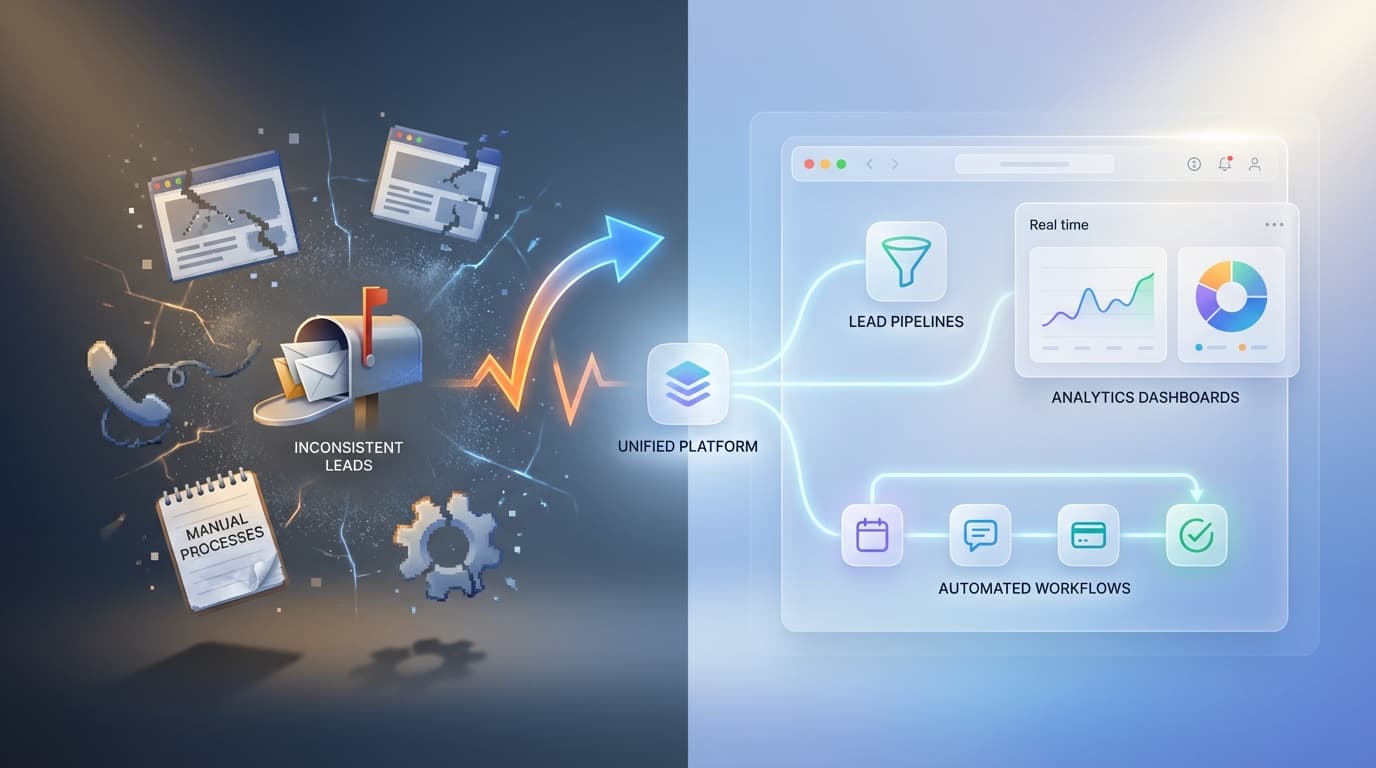
If you operate in B2B sales in 2026, you are likely feeling the squeeze. Customer Acquisition Costs (CAC) have skyrocketed over the last five years. The typical cold email inbox is heavily guarded by aggressive spam filters and sophisticated spam-sorting algorithms. Buyers are fatigued by generic, templated outreach that begins with, "I noticed your company is growing..."
Historically, the only way to scale B2B outbound and inbound pipeline generation was brute force: hiring armies of junior Sales Development Representatives (SDRs) or Business Development Representatives (BDRs). You paid them a base salary, bought licenses for ZoomInfo, Outreach, and LinkedIn Sales Navigator, and instructed them to make 100 cold calls and send 100 cold emails every single day.
This model is breaking. It is expensive, inefficient, and highly susceptible to turnover.
Enter the B2B AI SDR.
In this definitive guide, we are going to break down exactly what an AI Sales Development Representative is, how it fundamentally differs from the "dumb automation" of the past decade, and why companies deploying AI agents via platforms like LeadAdvisor AI are seeing their meeting booked rates triple while slashing overhead costs.
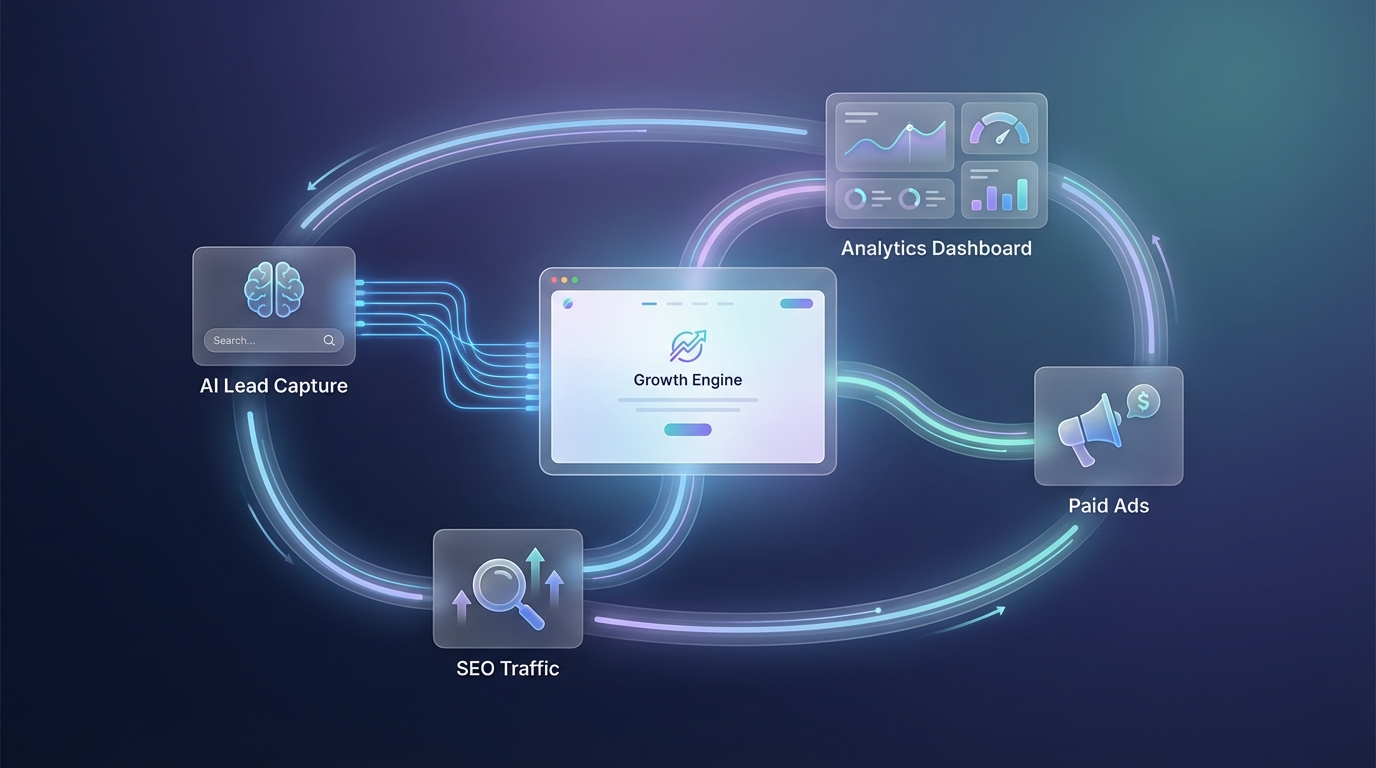 Website + AI = Growth Engine
1. What Exactly is an AI SDR?
A B2B AI SDR (Artificial Intelligence Sales Development Representative) is an autonomous software agent powered by Large Language Models (LLMs) designed to execute the entire top-of-funnel sales process without human intervention.
To understand what an AI SDR is, it helps to clarify what it is not.
It is NOT a Legacy "Mail Merge" Tool
In 2018, sales automation meant uploading a CSV of 5,000 contacts into a tool like Mailshake or Reply.io and sending a sequenced email where the only personalization was {{first_name}} and {{company_name}}. Buyers see through this instantly. An AI SDR does not use static templates. It dynamically writes every single email from scratch based on a deep, real-time analysis of the prospect.
It is NOT a Simple "Chatbot"
Old website chatbots operated on decision trees. If a user clicked "Pricing," the bot showed a pricing link. If the user asked a complex question, the bot broke and asked for an email address. An AI SDR understands the semantic intent behind complex B2B buyer questions, navigates objections, and engages in multi-turn negotiations.
The True Definition
A modern AI SDR operates with Contextual Intelligence. It acts as a digital clone of your highest-performing human rep. It researches accounts, identifies the Buying Committee, crafts hyper-personalized messaging based on recent news (like a funding round or a new product launch), handles objections ("We don't have budget until Q3"), and coordinates multi-channel touchpoints (Email, LinkedIn, SMS, and Website Chat) until a qualified meeting is booked on your Senior Account Executive's calendar.
2. The Core Capabilities of AI Sales Development
Why are Revenue Leaders aggressively reallocating headcount budgets toward AI software? It comes down to raw capability. Artificial Intelligence has crossed the threshold from "gimmick" to "mission-critical infrastructure."
Here are the core capabilities of an enterprise-grade B2B AI SDR:
A. Autonomous Account Research & Intent Detection
Before reaching out, a human SDR spends 5 to 10 minutes researching a prospect on LinkedIn, reading their recent company blogs, and checking 6sense or Clearbit for intent data. An AI SDR executes this research in milliseconds. It reads the prospect's LinkedIn profile, analyzes their company's latest 10-K filing, scans recent press releases, and cross-references your CRM to ensure no one else is currently working the account. It uses this intelligence to determine if the account is currently "in-market" for your solution.
B. Hyper-Personalization at Infinite Scale
"Personalization at scale" used to be a paradox. Not anymore. If an AI SDR determines that a VP of Engineering recently posted on LinkedIn about the struggles of migrating to AWS, the AI will draft an email that explicitly references that post.
Example AI-Generated Outreach:
"Hi Sarah, saw your post this morning regarding the latency issues your team faced during the recent AWS migration—it’s a massive headache. We recently helped [Competitor Name] reduce their post-migration latency by 40% using our edge-routing protocol. Would you be open to a 10-minute technical overview next Tuesday?"
The AI generates 10,000 of these hyper-personalized messages simultaneously across your Total Addressable Market (TAM), indistinguishable from a human touch.
C. Multi-Channel Orchestration
B2B buyers do not live in just one channel. An AI SDR orchestrates a cohesive narrative across platforms. Day 1: Connection request on LinkedIn referencing a shared connection. Day 2: Highly contextual Email. Day 4: If the buyer visits your website, the AI identifies their IP address and proactively engages them in the website chat widget, picking up the conversation exactly where the email left off.
D. Advanced Objection Handling
When a prospect replies to a cold email with, "We just signed a 2-year contract with your competitor," a junior human SDR might just mark the lead as "Closed Lost."
An AI SDR acts strategically. It accesses its training data to execute a competitive counter-play:
"I completely understand you're locked in with [Competitor]. However, many of our clients use our platform alongside [Competitor] specifically because their reporting module lacks custom BI exports. Since you're paid up through 2028, we are currently offering a parallel implementation at zero software cost for the first 12 months. Should we connect just to explore the dashboard capabilities?"
E. Frictionless Calendar Booking
The ultimate KPI of an SDR is meetings booked. The AI integrates directly with your team's Calendly, ChiliPiper, or Google Calendar. It navigates time-zone differences, reschedules instantly if the prospect creates a conflict, and natively creates the Event and Opportunity record in Salesforce or HubSpot.
3. AI SDR vs. Human SDR: The Economic Breakdown
If you are a VP of Sales or a Startup Founder, the decision to adopt AI SDRs ultimately comes down to the spreadsheet. Let’s break down the realistic ROI of hiring a junior human rep versus deploying LeadAdvisor AI.
The Cost of a Human SDR (US-Based)
Hiring humans is incredibly expensive, and the hidden costs are often ignored.
- Base Salary: $55,000 to $65,000
- On-Target Earnings (OTE): $80,000 to $90,000
- Taxes & Benefits (add ~20%): $16,000
- Tech Stack (CRM, LinkedIn, Data Providers, Dialers): $8,000
- Management Overhead (SDR Manager bandwidth): $10,000
- Total True Cost per SDR: ~$114,000 / year
The Reality of Ramp Time: When you hire a human SDR, they do not produce pipeline on Day 1. It typically takes 3 months to ramp a new rep. During this time, they are burning cash. Furthermore, SDRs have an notoriously high turnover rate (average tenure is 14 months). By the time they become highly profitable, they either get promoted to Account Executive or leave for a competitor, forcing you to restart the $114,000 cycle.
The Cost of an AI SDR
By contrast, an enterprise AI Sales Agent operates on a SaaS model.
- Software License: Highly variable, but roughly $1,000 to $3,000 / month depending on volume.
- Management Overhead: Near zero after initial prompt engineering and workflow setup.
- Total True Cost per AI SDR: ~$12,000 to $36,000 / year
The Infinite Ramp: An AI SDR requires exactly one onboarding period. Once you train it on your product, your battle cards, and your buyer personas, it never forgets. It never takes a sick day, it never asks for a raise, and it operates 24/7/365, engaging buyers in APAC while your human team in New York is asleep.
Furthermore, you can clone the AI instantly. If you acquire a massive new list of 100,000 leads, you don’t need to hire 10 new human SDRs to work it. You simply allocate more server compute to the AI, and the list is processed in days.
 Predictable Lead Flow & Growth
4. The 2026 Outbound Tech Stack
How does an AI SDR actually fit into an existing revenue organization? It does not replace your CRM; it supercharges it. Here is what the optimal, fully-automated Outbound Stack looks like today:
- The System of Record: Salesforce or HubSpot. This remains your single source of truth.
- The Data Engine: Apollo, ZoomInfo, or Clay. These tools scrape the internet for valid email addresses, phone numbers, and job titles.
- The Intent Layer: 6sense, Clearbit, or Bombora. These platforms monitor the web to tell you who is currently researching solutions in your space.
- The Brain (The AI SDR): This is where tools like LeadAdvisor AI sit. The AI sits in the middle. It ingests the contact data from Apollo, cross-references it with the intent signals from 6sense, drafts the personalized messaging, executes the send via your email infrastructure, and pushes all replies, meetings, and notes directly back into Salesforce.
The AI SDR acts as the connective tissue between raw data and pipeline revenue.
5. Will AI Replace Human Sales Reps Entirely?
This is the most common question in the B2B space right now. The short answer is: No, but it will fundamentally change their job descriptions.
AI is exceptional at logic, at scale, and at rapid data retrieval. Those are the exact requirements of top-of-funnel outbound sales (the traditional SDR role). AI is terrible at physical networking, reading micro-expressions in a boardroom, navigating complex internal company politics, and closing million-dollar enterprise contracts over a steak dinner. Those are the requirements of top-tier Account Executives (AEs).
What AI SDRs do is eliminate the "grunt work."
If your highly-paid, highly-skilled Account Executives are currently spending 40% of their work week digging through ZoomInfo, formatting CSV files, and cold-calling prospects who repeatedly hang up on them, you are misallocating your most expensive labor.
By deploying an AI SDR, you automate the exhausting, repetitive mechanics of pipeline generation. This ensures that every human sales rep on your payroll spends 100% of their time actively selling to qualified buyers who have already agreed to a meeting. You don't replace the human; you elevate them from a prospector to a pure closer.
6. How to Deploy Your First AI SDR in 30 Days
If you are a revenue leader convinced of the ROI, the next step is implementation. Deploying an AI SDR is significantly faster than hiring and training a human team. Here is the 30-day blueprint.
Week 1: Knowledge Ingestion
Your AI needs to know everything about your company. You upload your entire website, your historical sales call transcripts (from Gong or Chorus), your competitor battle cards, and your pricing matrices. The AI uses this data to build its "brain."
Week 2: Infrastructure & Deliverability
Because you will be sending emails at scale, email deliverability is critical. You will utilize secondary domains (e.g., if you are acme.com, you buy tryacme.com and getacme.com), warm up the inboxes using automated tools, and configure SPF, DKIM, and DMARC records to ensure your AI's emails land in the Primary inbox, not the Spam folder.
Week 3: Prompt Engineering & Guardrails
You don't want the AI going rogue. You establish strict guardrails. For example, you might instruct the AI: "You are never authorized to guarantee a discount greater than 10%. If a prospect demands 20%, you must pivot the conversation to booking a meeting with an AE."
Week 4: The Soft Launch
You turn the AI on, but initially limit its outreach to 50 prospects a day. You monitor every single reply heavily. When the AI handles an objection perfectly, you give it positive reinforcement. When it missteps, you intervene and tweak the prompt. Within 14 days of the soft launch, the AI's accuracy will surpass that of an average human rep, and you can scale the outreach to thousands of prospects per day.
Conclusion: The Future of Pipeline is Autonomous
The B2B sales landscape is undergoing its most radical transformation since the invention of the CRM. In 2026, relying purely on human labor or legacy rule-based email sequences to generate pipeline is a strategic liability.
B2B buyers demand instant, hyper-relevant, and highly intelligent communication. Subpar outreach is no longer just ignored; it damages your brand equity.
An autonomous B2B AI SDR provides the ultimate competitive advantage: infinite scale tied strictly to elite, human-level intelligence, operating at a fraction of the cost of a traditional sales floor. The companies that embrace this technology will command their markets; those that do not will find their acquisition costs mathematically unsustainable.
Are you ready to automate your outbound pipeline and free your human team to close more deals?
Discover how a seamlessly integrated AI Sales Agent can transform your revenue engine. LeadAdvisor AI offers enterprise-grade automation to scale your pipeline, qualify inbound flow, and orchestrate complex outbound touches effortlessly.
The future is autonomous. Make sure your revenue team is ready.