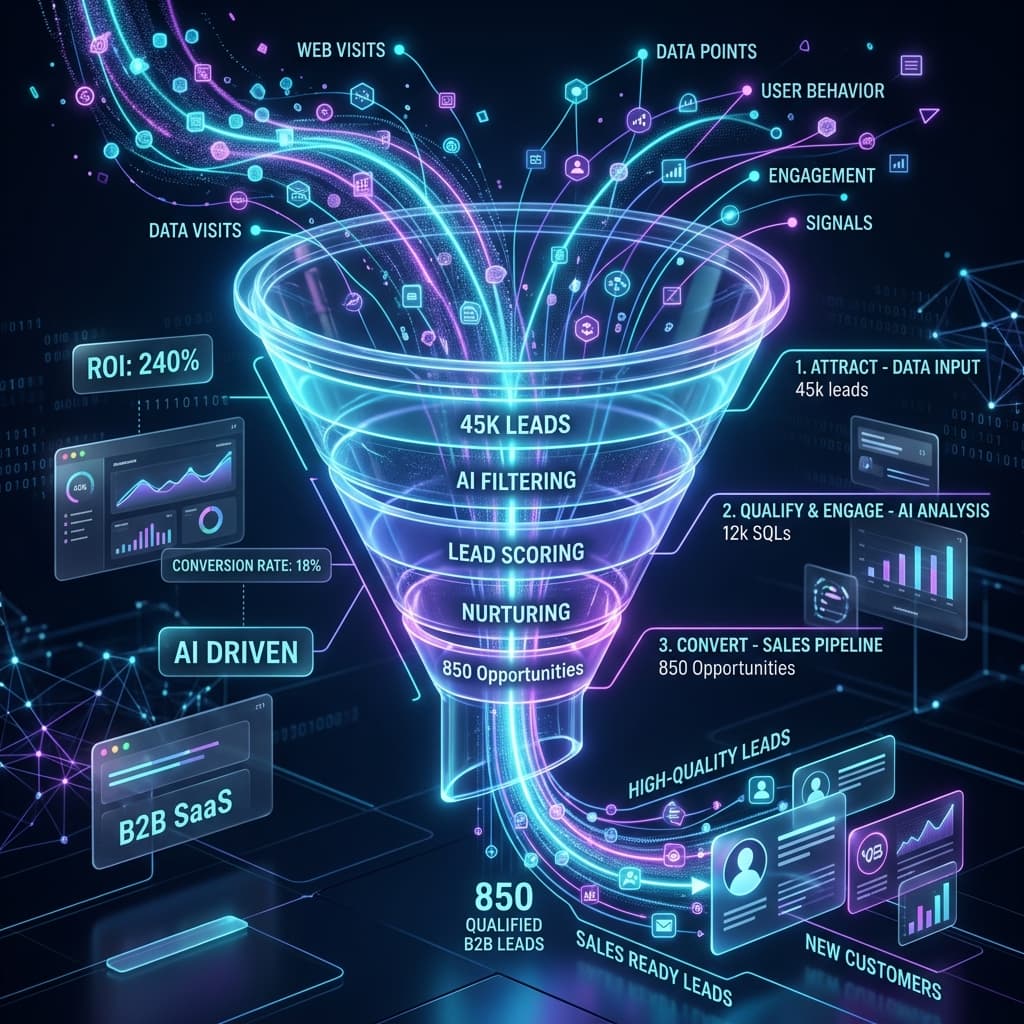
The Ultimate Guide to AI Lead Generation: Stop Chasing Bad Leads and Automate B2B Sales
The Ultimate Guide to AI Lead Generation: How to Stop Chasing Bad Leads and Automate B2B Sales
The era of brute-force B2B outbound sales is officially over.
If you are a B2B founder, a Chief Revenue Officer, or a sales leader, you are likely looking at your metrics and noticing a disturbing trend: your customer acquisition cost (CAC) is rising, your email open rates are plummeting, and your Sales Development Representatives (SDRs) are burning out faster than ever.
The traditional playbook—buying massive lists of data, loading them into sequencing tools, and blasting out thousands of generic emails—no longer works. In 2026, buyers are overwhelmed by "spray and pray" outreach. Spam filters have become incredibly sophisticated, instantly penalizing domains that send low-relevance emails.
The result? You are spending a massive amount of time, money, and energy chasing leads that simply will not convert.
But a massive shift is happening. The highest-performing sales organizations are moving away from manual, high-volume prospecting and transitioning to AI lead generation. By deploying autonomous AI sales agents, companies are finally able to solve the core pain points of B2B sales, achieving hyper-personalization at an infinite scale.
In this comprehensive guide, we will break down exactly why your current B2B lead generation strategy is failing, and how AI agents can completely rebuild your revenue pipeline.
The 4 Biggest Pain Points in B2B Sales (And How AI Solves Them)
To understand why AI is revolutionizing sales, we have to look closely at the friction points that are currently breaking your funnel.
Pain Point 1: The "Data Decay" and Inaccurate Targeting Trap
The Problem: Data is rotting faster than you can use it. You buy a list of 10,000 "ideal customer profile" (ICP) contacts. By the time your SDRs work through that list over the next three months, 25% of those people have changed jobs, companies have shifted budgets, and the contact information is useless. Your SDRs spend 40% of their day just verifying data rather than actually selling.
The AI Solution: Real-Time Dynamic Enrichment AI lead generation doesn't rely on static, purchased lists. Instead, autonomous AI agents constantly monitor the digital landscape in real-time. They track live intent signals: job changes, new funding rounds, software stack updates, and social media activity.
Instead of working from a decaying spreadsheet, an AI agent dynamically enriches a profile the exact moment it decides to reach out. It pulls the latest SEC filings, LinkedIn posts, and company news, ensuring that every piece of data is 100% accurate the second the email is sent.
Pain Point 2: The "Personalization vs. Scale" Dilemma
The Problem: Personalization works. If an SDR spends 20 minutes researching a prospect's recent podcast appearance and crafts a bespoke email, the reply rate is high. But an SDR can only write 15 of those emails a day. On the flip side, you can use automation to send 1,000 emails a day, but because they only use basic merge tags (Hi {{First_Name}}), they go straight to spam. You are forced to choose between quality and quantity.
The AI Solution: Hyper-Personalization at Infinite Scale This is where AI sales agents truly shine. Utilizing advanced Large Language Models (LLMs) and Retrieval-Augmented Generation (RAG), an AI agent can perform that 20-minute deep-dive research in milliseconds.
The AI can read a prospect's recent blog post, analyze their company's Q3 earnings report, and weave those specific insights into a highly relevant, custom-tailored message. Because it is software, it can do this for 10,000 prospects simultaneously. You finally get the conversion rates of bespoke human outreach with the scale of enterprise automation.
Pain Point 3: The "Speed to Lead" Failure
The Problem: A high-intent prospect downloads your whitepaper or submits a pricing inquiry on a Friday evening. Your SDR team doesn't see it until Monday morning. By the time they follow up, the prospect has already booked a demo with your competitor who had an automated system in place. In the modern zero-wait economy, if you aren't responding within 5 minutes, your chances of closing the deal drop by 80%. (Learn more about the true cost of missed leads).
The AI Solution: 24/7 Autonomous Engagement AI agents do not sleep, take weekends off, or log out at 5 PM. They monitor your inbound channels and intent signals 24/7.
The exact moment a prospect exhibits buying behavior, the AI agent engages. It can instantly fire off a contextual email, engage the user in a smart conversational chat on your website, and even qualify the lead and book a meeting directly onto your Account Executive's calendar—all while your human team is asleep.
Pain Point 4: The High Cost of Scaling Sales Teams
The Problem: When you rely on human SDRs for top-of-funnel generation, your revenue growth is locked to your headcount. To get 2x more leads, you have to hire 2x more SDRs. This drastically increases your overhead, management burden, and software licensing costs, destroying your profit margins.
The AI Solution: Decoupling Revenue from Headcount An autonomous AI SDR operates at a fraction of the cost of a human team. By automating the grueling, repetitive work of prospecting, initial outreach, and follow-up sequences, you can scale your outbound volume exponentially without adding a single new hire.
This doesn't replace your sales team; it elevates them. Your human Account Executives are freed from prospecting hell and can spend 100% of their time doing what humans do best: building relationships, running strategic discovery calls, and closing deals.
Deep Dive: How Signal-Based AI Actually Works
You might be wondering, how does this actually look in practice? The secret lies in a methodology called Signal-Based Selling.
Traditional outbound is calendar-based: Send email 1 on Day 1, email 2 on Day 3. AI outbound is event-based. It waits for a "signal."
Here is the exact workflow of a top-tier AI sales agent like LeadAdvisorAI:
- Signal Detection: The AI monitors a specific trigger. Let's say your target market is SaaS companies, and your product helps with onboarding. The AI monitors job boards for companies posting a "Head of Customer Success" role.
- Instant Contextual RAG: The moment Company X posts that job, the AI triggers. It instantly scrapes Company X's website, understands their product, and reviews the job description.
- Message Generation: The AI drafts a message to the CEO of Company X: "Saw you're actively hiring a Head of CS. While you're scaling that team, I noticed your current onboarding flow requires manual intervention. We help SaaS companies automate..."
- Omnichannel Execution: The AI doesn't just send an email. It might send a LinkedIn connection request with a personalized note, followed by an email two days later referencing the connection request.
- Autonomous Follow-up & Handoff: If the prospect asks a question ("How does this integrate with Salesforce?"), the AI agent reads your technical documentation, replies accurately, and suggests a time to chat. Once the prospect agrees, the AI books the meeting and hands the full context over to your human closer.
Actionable Steps: Building Your AI Lead Generation Strategy
Ready to stop chasing bad leads? Here is a step-by-step framework to modernize your strategy today.
Step 1: Define Your Signals, Not Just Your ICP
Stop just defining your target by "B2B SaaS in North America." Start defining the events that indicate a need for your product. Are they raising money? Are they hiring? Did their competitor just launch a new feature? Identify the signals.
Step 2: Clean Up Your Deliverability Infrastructure
AI can write the perfect email, but it won't matter if it goes to spam. Ensure your technical setup (DMARC, DKIM, SPF) is flawless. Use multiple secondary domains and warm them up properly.
Step 3: Implement an Autonomous Agent Platform
Move away from legacy sequencing tools that require manual list uploading. Implement an end-to-end AI platform like LeadAdvisorAI that handles the scraping, the enrichment, the writing, and the sending all in one unified system.
Step 4: Train Your AI on Your "Brain"
Upload your best case studies, your handling of common objections, and your brand voice guidelines into your AI agent's knowledge base. The AI needs to sound like your smartest, most experienced rep, not a generic robot.
The Tangible ROI of AI Sales Agents
The data is clear. Teams that have transitioned to AI-driven, signal-based selling are seeing massive improvements across the board:
- Reply Rates: Jumping from the industry average of 1-2% up to 15-25%, simply because the outreach is relevant and timely.
- Meeting Show Rates: Prospects who interact with highly competent AI agents before a meeting have a significantly higher intent, reducing no-show rates.
- Cost Per Lead (CPL): Dropping by as much as 80% as the reliance on expensive, bloatware data providers and massive SDR headcounts decreases.
Conclusion: Don't Get Left Behind
The transition to AI lead generation is not a passing trend; it is a fundamental evolution in how B2B companies go to market. Companies that cling to manual, static outreach will soon find themselves shouting into an empty room, their emails buried in spam folders, while their competitors effortlessly engage buyers at the perfect moment.
Stop wasting your time and budget chasing bad leads. It's time to put your revenue engine on autopilot.
👉 Book your LeadAdvisorAI Demo today and let us show you how our autonomous agents can transform your pipeline in under 24 hours.