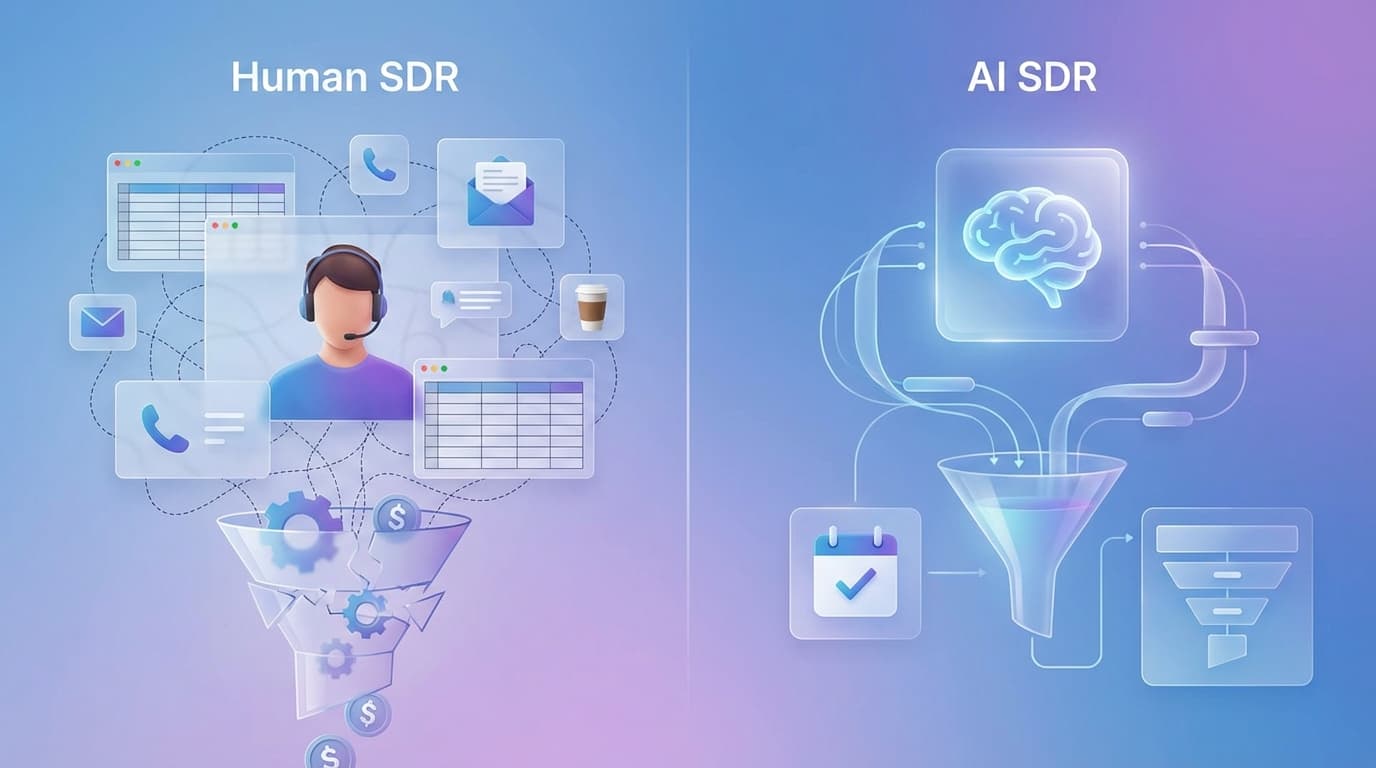
AI SDR vs. Human SDR: Is Hiring a Junior Rep Worth It in 2026?
AI SDR vs. Human SDR: Is Hiring a Junior Rep Worth It in 2026?
In the hyper-competitive landscape of modern B2B SaaS, the math behind customer acquisition is breaking down. Revenue leaders are facing an unsolvable equation using legacy methods. Buyer fatigue is at an all-time high, email open rates are plummeting due to aggressive spam filters, and the sheer volume of outreach required to secure a single booked meeting has quadrupled.
For the past decade, the standard playbook for scaling revenue was simple: hire more Sales Development Representatives (SDRs). You add headcount, you buy more software licenses, you tell them to hit the phones and send a thousand cold emails a week, and theoretically, your pipeline grows.
Today, that playbook is a financial black hole.
The emergence of the Artificial Intelligence Sales Development Representative (AI SDR) has completely rewritten the economics of outbound and inbound pipeline generation. By deploying autonomous agents capable of researching, personalizing, and negotiating at scale, companies are no longer forced to choose between massive overhead costs and empty calendars.
If you are a founder, a VP of Sales, or a Revenue Operations leader deciding where to allocate your budget this quarter, this article is for you. We are going to conduct a ruthless, line-by-line financial autopsy comparing the true cost of a human SDR against an enterprise AI SDR, and explain why the unit economics of 2026 demand automation.
The True Cost of a Human SDR
When founders build their financial models, they frequently underestimate the actual cost of a human sales rep. They look at the base salary and assume that is the extent of their financial liability. In reality, a human SDR is a massive capital expenditure wrapped in hidden fees.
Let us break down the conservative, realistic cost of a single, US-based human SDR deployed in a modern tech hub.
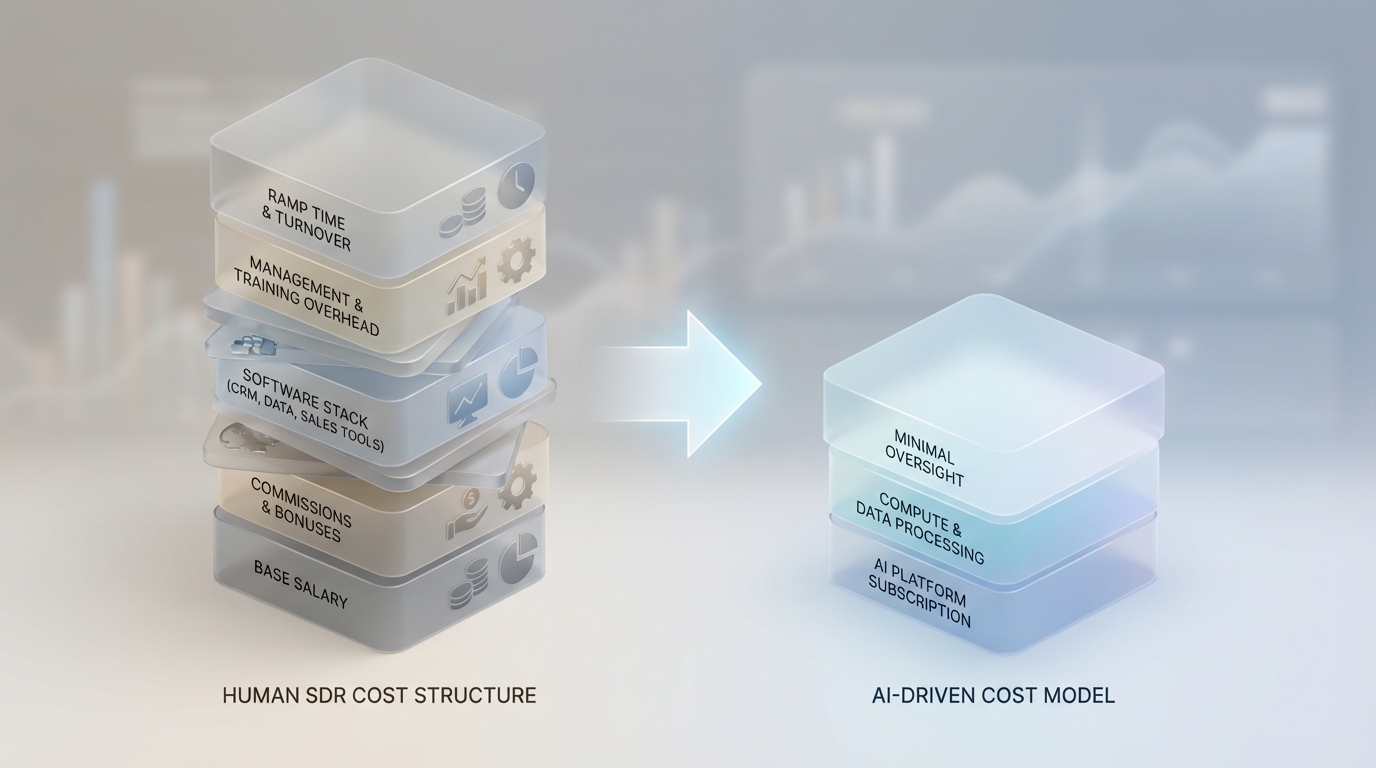
- Base Salary: The average base salary for an entry-level to mid-level SDR ranges from $55,000 to $65,000.
- On-Target Earnings (OTE): To incentivize the rep, you must offer an aggressive commission structure. A standard 70/30 or 60/40 split pushes their total possible compensation to between $80,000 and $90,000 annually.
- Taxes, Benefits, and Overhead: Federal taxes, state taxes, health insurance, 401k matching, and office space (or remote work stipends) typically add 20 to 25 percent on top of the base salary. This adds roughly $16,000 to your ledger.
- The Modern Outbound Tech Stack: A human cannot perform outbound sales without software. You need a CRM seat (Salesforce or HubSpot). You need a data provider for phone numbers and emails (ZoomInfo or Apollo). You need an email sequencing tool (Outreach or SalesLoft). You need an intent data platform (6sense). You need LinkedIn Sales Navigator. These licenses collectively cost between $8,000 and $12,000 per rep, per year.
- Management and Training Bandwidth: Sales reps require constant coaching, 1-on-1s, and QA reviews. If an SDR Manager earning $140,000 manages eight reps, you are allocating $17,500 of that manager's salary purely to keeping that single SDR productive.
When you total these expenses, the true cost of a single human SDR easily eclipses $120,000 per year.
The Hidden Killers: Ramp Time and Turnover
Even if you are perfectly comfortable spending $120,000 a year on a human SDR, the financial logic assumes they are performing at peak capacity for all 12 months. This is a dangerous assumption.
Human reps do not produce pipeline on their first day. It requires a grueling onboarding process. They need to learn your product architecture, they need to memorize your competitor battle cards, they need to understand your ideal customer profile, and they need to practice their cold call scripts.
The industry average ramp time for a new SDR is exactly 3.2 months. During this entire quarter, you are paying their salary, their software seats, and their management overhead, but they are generating virtually zero revenue. You are burning cash simply to prepare them to do their job.
Furthermore, the SDR role is notoriously difficult. It involves facing hundreds of rejections per week. Because of this, the average tenure for an SDR in B2B tech is barely 14 months.
If a rep takes 3 months to ramp, and leaves at month 14, you only received 11 months of actual productivity. When they leave, whether they quit from burnout or get promoted to Account Executive, you lose all the institutional knowledge you spent a quarter building. You are forced to hire a new rep and restart the agonizing, expensive 3-month ramp phase all over again.
The Unfair Economic Advantage of the AI SDR
When we compare that financial reality to the deployment of an AI SDR, the contrast is staggering.
Platforms like LeadAdvisor AI operate on a SaaS (Software as a Service) model. Instead of paying a fluctuating, unpredictable combination of salaries, commissions, and hidden overhead, you pay a flat or purely usage-based fee.
- The Cost Structure: A robust, enterprise-grade AI Sales Agent typically costs between $12,000 and $36,000 per year, depending largely on server compute limits and integration complexity.
- Software Consolidation: Because an AI SDR natively executes the duties of a data scrape, an email sequencer, and a routing tool, you can often cancel your expensive legacy subscriptions to tools like Outreach and Mailshake.
- Zero Management Overhead: AI does not need a Friday afternoon motivational 1-on-1. It does not require performance improvement plans. Once the workflows and prompts are locked in, your management overhead drops to zero.
The most devastating advantage, however, is the concept of the Infinite Ramp.
When you deploy an AI SDR, it integrates directly with your existing knowledge base. It reads your entire website. It consumes your PDFs, whitepapers, and historical Gong call transcripts. It learns your entire business model in seconds.
It never forgets a detail. It never mixes up your pricing tiers on a late Friday afternoon. It never takes a sick day during your busiest product launch week. It operates 24 hours a day, 7 days a week, 365 days a year. When a critical prospect in Tokyo submits a demo request at 3:00 AM your local time, the AI SDR is awake. It instantly researches their company, drafts a highly contextual reply in their native language, navigates their budget objections, and books a meeting on your calendar before your human team has even poured their morning coffee.
 Infinite Scale & Always-On Pipeline
Scalability on Demand
 Team Overwhelmed vs AI Efficiency
Consider the logistics of scaling your pipeline.
If your marketing team successfully pulls off an incredible campaign that generates 10,000 raw leads overnight, what happens next?
If you rely on human SDRs, you have a massive problem. A human rep can effectively personalize and manage perhaps 50 to 100 new, high-touch leads per day. To process 10,000 leads before the intent goes cold, you would need to rapidly hire, onboard, and train ten brand new reps. This is logistically impossible. The leads will rot in your CRM, and the marketing budget will be wasted.
If you rely on an AI SDR, scaling is simply a matter of processing power. The AI can analyze all 10,000 leads, identify the decision-makers, check their recent LinkedIn activity for pain points, draft 10,000 totally unique outreach emails, and deploy them across multiple domains simultaneously. It does this flawlessly over a weekend without breaking a sweat.
Does This Mean Human Reps Are Obsolete?
No. This is the most crucial distinction modern revenue leaders must understand.
Deploying an AI SDR does not mean firing your entire sales organization. It means elevating them.
Artificial Intelligence is mathematically superior at logic, data retrieval, and operating at infinite scale. This makes it the perfect entity for top-of-funnel outbound sales, lead qualification, and calendar booking.
Artificial Intelligence is fundamentally incapable of building deep, empathetic human trust. It cannot read the subtle, nervous body language of a CFO in a boardroom. It cannot take a VP of Procurement out to a steak dinner to hash out the final redlines of a massive enterprise contract.
You need human Account Executives (AEs) to close deals.
The tragedy of the modern sales floor is that highly skilled, highly paid AEs are currently wasting 40 percent of their working hours digging through databases, writing cold outreach emails, and doing the grunt work of pipeline generation.
By deploying an AI SDR, you entirely eliminate the agonizing top-of-funnel mechanics. Your Account Executives will wake up every single morning to a calendar packed with highly qualified, perfectly vetted prospects who are actively ready to buy. Your humans get to focus 100 percent of their energy on closing revenue.
Conclusion: The Math In 2026
The debate between human brute force and AI automation is over.
You can continue to spend $120,000 a year to hire a junior employee who takes a quarter to ramp, requires constant hand-holding, drops leads on weekends, and works 8 hours a day. Or, you can spend a fraction of that cost to deploy an incredibly sophisticated, tirelessly precise AI Sales Agent that works 24 hours a day and scales infinitely on demand.
For more foundational context on how these agents actually pull data and reason through conversations, we highly recommend reading our primary guide: What is a B2B AI SDR? The Complete Guide for 2026.
The unit economics simply do not lie. To survive in the current B2B landscape, you must automate the top of your funnel. If you are ready to stop burning cash on inefficient outreach and start booking highly qualified meetings on autopilot, explore how LeadAdvisor AI can transform your revenue engine today.