
The Enterprise ABM Playbook for 2026: Scaling Seven-Figure Pipeline with AI SDRs
The Enterprise ABM Playbook for 2026: Scaling Seven-Figure Pipeline with AI SDRs
For the modern Chief Revenue Officer (CRO), Account-Based Marketing (ABM) has always been a paradox. On one hand, it represents the highest-value strategy in B2B sales: focusing 100 percent of your energy on the few hundred accounts that could truly move the needle. On the other hand, it has historically been the most expensive and least scalable motion in the entire go-to-market stack.
In 2026, the traditional 1:1 ABM model is facing a terminal crisis.
The sheer volume of digital noise has made it nearly impossible for a human Sales Development Representative (SDR) to break through. When your target account has a "Buying Committee" of seven to twelve stakeholders, manual research and outreach are simply too slow. By the time a human rep has finished researching the VP of Engineering, the CFO has already moved on to a competitor.
Enter the Autonomous Enterprise ABM Engine.
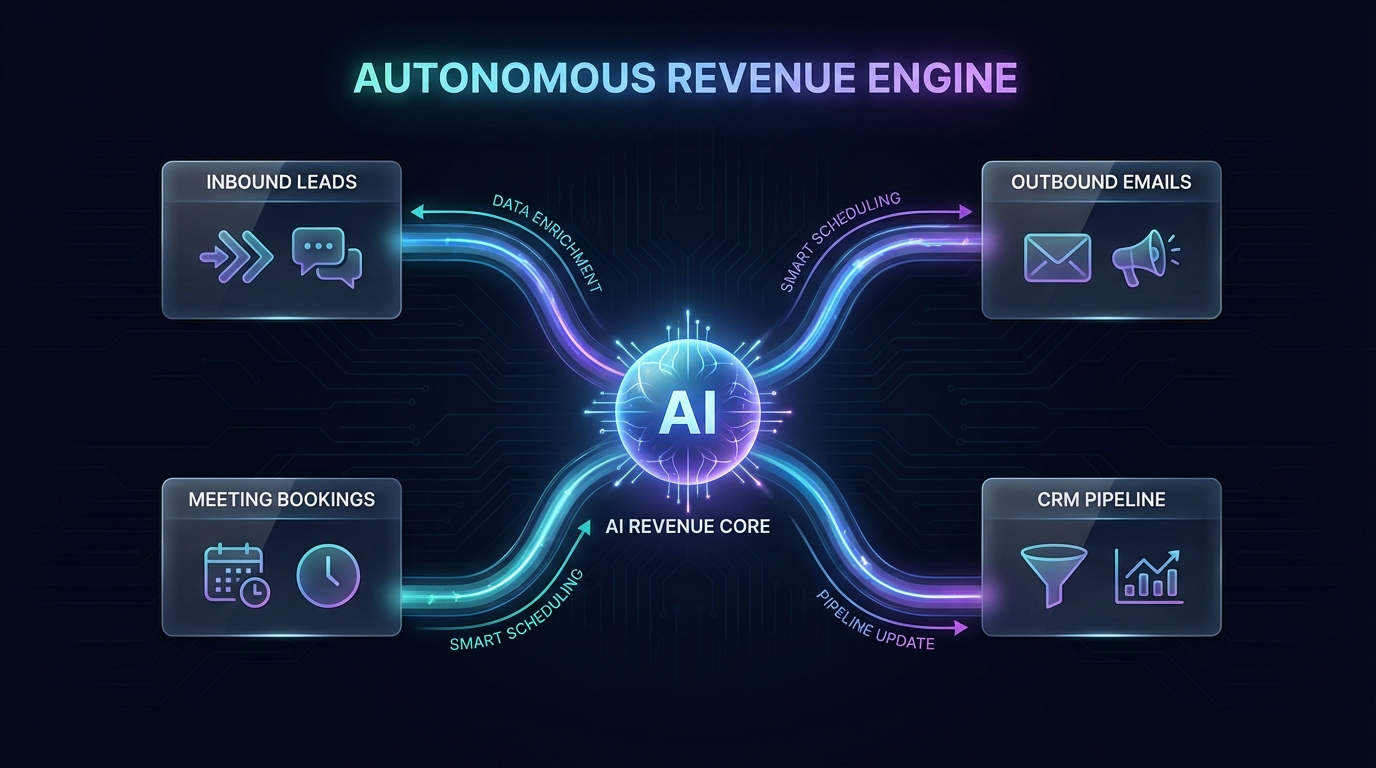
This playbook details how the world’s most sophisticated revenue organizations are using LeadAdvisor AI to orchestrate specialized AI SDRs. This is about more than just "automated email." It is about a structural shift from manual prospecting to Account-Based Intelligence (ABI) at infinite scale.
1. The Structural Failure of Manual ABM
To scale a seven-figure pipeline, you cannot rely on junior reps spending forty hours a week scraping LinkedIn. The legacy ABM model suffers from three fatal flaws in the current market:
- The Research Latency Gap: It takes a human roughly two hours to deeply research a single enterprise account. For a list of 500 target accounts, that is 1,000 human hours before a single message is sent.
- The Buying Committee Blindspot: Most human reps focus on one or two "Power Users." In enterprise deals, the real decision-makers are often invisible (legal, procurement, or IT security).
- The Inconsistent Touchpoint Problem: Strategic ABM requires persistent, multi-channel follow-ups over months. Humans inevitably drop the ball on low-intent leads to chase "hot" ones, leaving millions in potential revenue to wither in the CRM.
The AI SDR solves these issues by operating at the speed of compute rather than the speed of caffeine.
2. Moving from ABM to Account-Based Intelligence (ABI)
The first step in the 2026 playbook is the transition from "Marketing" to "Intelligence." Before you send a single message, your AI Agent must build a comprehensive map of the target organization.
Mapping the Modern Buying Committee
Large enterprise deals are rarely won by one person. Research shows that the average B2B buying group for a complex solution now includes 7.4 stakeholders. Your AI SDR uses Autonomous Intelligence to identify every individual in this group:
- The Economic Buyer: Usually the CXO or VP who owns the budget and cares about ROI.
- The Technical Evaluator: The IT or Security leader who cares about integrations and compliance.
- The End-User Champion: The person whose daily life will be improved by your software.
- The Blocker: The stakeholder who might feel threatened by the change.
By scanning public news, recent 10-K filings, and social triggers, the AI builds a "Sentiment Mesh" for the account. It understands that the VP of Sales just mentioned a "hiring freeze" on a podcast, while the CEO just announced an "AI-first expansion" in the annual report. These conflicting triggers become the bedrock of your personalized outreach.
 AI System Analyzing Account Intelligence
3. Orchestrating the AI SDR "Orchestra"
A winning ABM strategy in 2026 is not a solo performance; it is an orchestra. You do not just send one email. You orchestrate a synchronized, multi-channel narrative that surrounds the target account.
The Multi-Channel Synchronization Framework
When you deploy LeadAdvisor AI for Enterprise ABM, the Agents coordinate their efforts across three primary fronts:
- Direct Contextual Email: Hyper-personalized messages that reference specific corporate goals or executive quotes.
- Social Connectivity (LinkedIn): Proactive engagement with stakeholder content, followed by connection requests that offer legitimate value rather than a "pitch."
- Conversational Web Capture: If any stakeholder visits your site, the AI recognizes the account instantly and provides a personalized welcome message: "Welcome back from [Company Name]. I saw your team is currently tackling [Specific Pain Point]. Would you like to see a case study on how we solved that?"
This "surround sound" approach ensures that your brand becomes the default choice when the committee finally meets. If you are looking to understand how this fits into your current team, read our guide on The Hybrid Sales Development Playbook.
4. The Economics: Why AI ABM Scales Seven-Figure Deals
The financial argument for AI-enabled ABM is irrefutable. In the legacy model, a high-touch ABM program requires a dedicated SDR for every five to ten "Tier 1" accounts. The math simply does not work for mid-market growth.
The ROI Shift
- Legacy Cost: $150,000 (Human Salary + Benefits + Tech Stack) to manage 20 high-value accounts. Cost per Account: $7,500.
- AI SDR Cost: $2,500 (Software License) to manage 500 high-value accounts with higher precision. Cost per Account: $5.
This 1,500x difference in efficiency allows you to treat every account in your Total Addressable Market (TAM) with the "Diamond Level" care previously reserved for the Fortune 100. For more on these economics, see our deep dive on AI SDR vs Human SDR ROI.
5. The Handoff: From Autonomous Pipeline to Human Closing
The goal of an AI SDR is not to close the deal. It is to protect the time of your most expensive assets: your Account Executives (AEs).
Once the AI detects "High Intent" (e.g., the CFO asks for a security whitepaper or the VP of Engineering requests a technical demo), it initiates a Warm Handoff.
The Meeting Brief: Your AE’s Competitive Edge
When a meeting is booked on the human AE’s calendar, the AI generates a comprehensive dossier:
- Transcript History: Every word exchanged between the AI and the stakeholders.
- Pain Point Analysis: A summary of the specific "friction" points identified during the nurture phase.
- Stakeholder Sentiment: A ranking of who in the committee is "pro-deal" and who is "hesitant."
- Suggested Closing Strategy: Based on the data, the AI recommends which case study or ROI calculator will be most effective during the live call.
This ensures that your human closers never walk into a call "cold." They are informed, prepared, and ready to close seven-figure revenue. This is the core of a high-performance AI Lead Qualification strategy.
6. Implementing AI ABM in 30 Days
Scaling an enterprise pipeline does not require a six-month implementation cycle. The transition to an AI-first ABM motion can be completed in four weeks:
- Week 1 (Mapping): Integrate LeadAdvisor AI with your CRM (Salesforce or HubSpot) and define your "Ideal Customer Profile" (ICP).
- Week 2 (Ingestion): Feed the AI your best sales collateral, whitepapers, and competitor battle cards.
- Week 3 (Pilot): Launch a "Human-in-the-Loop" pilot for 50 accounts to refine the brand voice and messaging triggers.
- Week 4 (Scale): Remove the manual review for lower-tier accounts and let the AI operate autonomously across your entire target list.
Conclusion: The Era of Autonomous Account Growth
In 2026, the companies that win are not the ones with the largest sales floors. They are the ones with the most intelligent sales engines.
The "Enterprise ABM Playbook" is no longer about brute force. It is about using Agentic AI to become a precision instrument. By automating the research, the mapping, and the multi-channel nurture, you empower your human team to focus on the one thing a computer cannot do: building deep, emotional trust with human buyers.
The future of the seven-figure pipeline is autonomous. Those who embrace the AI SDR today will be the ones dominating their market share tomorrow.
LeadAdvisor AI is built specifically for the complexities of enterprise sales. Whether you are navigating global procurement or targeting specific engineering leads, our agents provide the "Floor of Productivity" required to scale.
If you are ready to stop guessing and start scaling, we recommend starting with our B2B AI SDR Complete Guide to see how we are redefining the top of the funnel for 2026.
 Autonomous Revenue Engine Engine