The Death of the 'Contact Us' Form: Why Static Web Forms Are Killing Your Conversion Rates
The Death of the 'Contact Us' Form: Why Static Web Forms Are Killing Your Conversion Rates
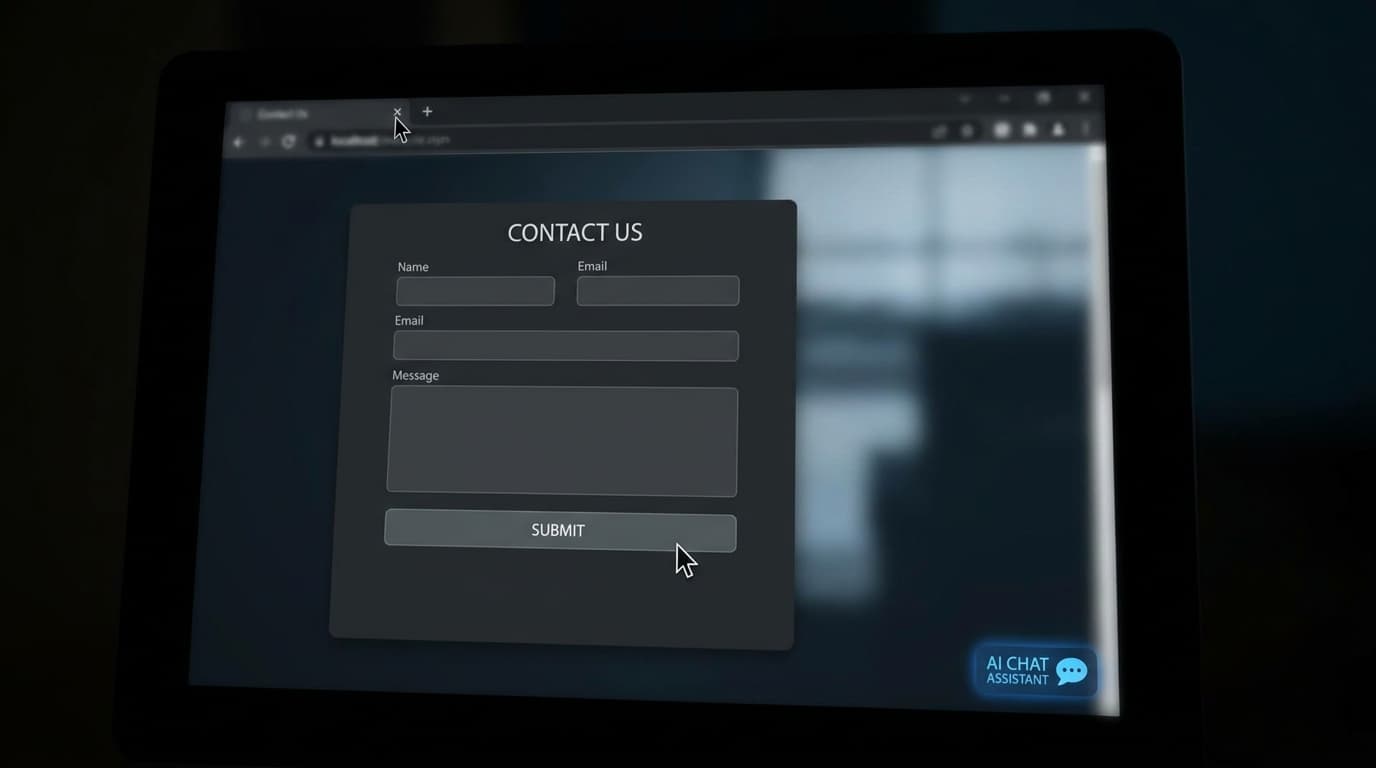
Look at your website right now. You likely have a big, beautiful "Contact Us" or "Request a Quote" button in the top right corner. When a high-intent user clicks it, they are taken to a static page with a 5-to-10 field form asking for their First Name, Last Name, Email, Phone, Company, Job Title, and a mandatory "How can we help you?" text box.
For the last two decades, this has been the absolute gold standard of B2B and B2C lead generation.
In 2026, it is officially a massive conversion killer.
Modern buyers have evolved. They are conditioned by on-demand services, instant messaging, and immediate gratification. When a high-intent prospect lands on your website and is forced to fill out a static form—only to see a generic "Thanks! Someone will be in touch within 24-48 hours" auto-responder—they experience massive friction.
By the time your sales team actually follows up the next day, that prospect has already engaged with a competitor who gave them instant answers.
In this comprehensive guide, we will break down exactly why the traditional contact form is bleeding your pipeline dry, the psychology behind form abandonment, and how AI-driven conversational lead generation is the ultimate replacement to skyrocket your conversion rates.
4 Reasons Your Web Forms Are Bleeding Leads
If you are pouring thousands of dollars into Google Ads, SEO, and content marketing just to drive traffic to a static web form, you are actively burning your marketing budget. Here is why the traditional form is failing you:
1. High Friction Leads to Massive Form Abandonment
Every extra field you add to a form drastically reduces your conversion rate. Asking a user to type out their life story before they even know if your product or service can actually solve their problem is a huge barrier to entry.
Industry data shows that the average form abandonment rate hovers around 68%. That means nearly 7 out of 10 people who want to talk to you give up because the process is too tedious. Furthermore, studies show that reducing the number of form fields from 11 to 4 can increase conversions by 120%, but even a 4-field form cannot compete with the frictionless experience of a conversation.
2. The "Zero-Wait" Expectation
We live in an era where consumers can order a car in 2 minutes and get groceries delivered in 15 minutes. The idea of waiting 24 to 48 hours for a sales rep to reply to an email is completely unacceptable to the modern buyer.
- Fact: The odds of qualifying a lead decrease by 400% if you wait more than 5 minutes to respond. (Learn more about the true cost of missed leads).
- Fact: 78% of B2B customers buy from the vendor that responds first.
If a prospect has a specific question about your pricing or integrations, a form acts as a roadblock. It forces them to wait. Conversational AI, on the other hand, provides an instant answer and capitalizes on their highest moment of intent.
3. One-Way Communication Kills Momentum
Forms are transactional, not relational. They are a one-way street where the prospect throws data into a black box and simply hopes someone cares on the other side.
This completely halts buying momentum and is a major reason why businesses lose customers. A prospect is hottest the exact second they are on your website, navigating your features page. If you don't engage them immediately, their attention shifts to the next tab in their browser.
4. Poor Mobile Experience
Over 50% of B2B web traffic and up to 80% of B2C traffic comes from mobile devices. Typing out 7 fields of text on a smartphone keyboard, dealing with auto-correct errors, and navigating clunky dropdown menus is a nightmare. Conversational interfaces (like messaging apps) are native to mobile users and feel infinitely more natural.
The Psychology of the "Micro-Commitment"
To understand why conversational AI outperforms static forms, you need to understand the psychology of the "Micro-Commitment."
When a user sees a massive form, their brain processes it as "work." They immediately calculate the effort required versus the perceived reward (which is often just an automated "we will be in touch" email).
A conversational AI agent flips this dynamic completely:
- Value First: The AI asks, "Hi! Are you looking for our enterprise pricing or just browsing?"
- Low-Friction Click: The user clicks "Enterprise Pricing" (zero typing required).
- Instant Gratification: The AI replies instantly: "Great! Our enterprise tier starts at $99/mo and includes unlimited seats. What CRM are you currently using?"
- The Hook: The user is now engaged in a two-way dialogue. After the AI answers their questions and establishes trust, it seamlessly asks, "I can have an Account Executive walk you through a custom demo. What's the best email to send the calendar invite to?"
Because the user has already received value and made several low-friction "micro-commitments," they are exponentially more likely to hand over their contact information.
The Solution: Autonomous Conversational Lead Capture
The highest-converting websites in the world are rapidly replacing their static forms with Autonomous AI Sales Agents.
These are not the clunky, frustrating "rule-based" chatbots from 2018 that forced you into dead-end menus. Modern AI agents are powered by advanced Large Language Models (LLMs) and trained specifically on your company's data, documentation, and sales playbooks.
Here is how an AI agent completely rebuilds your inbound pipeline:
1. Instant Pre-Qualification and Routing
Instead of your sales team wasting hours sifting through junk leads submitted via forms, the AI agent handles the discovery phase. It asks qualifying questions (Budget, Timeline, Authority, Need) in a natural, conversational tone.
If the lead is disqualified (e.g., their budget is too small), the AI politely points them to a self-serve resource. If the lead is highly qualified, the AI routes them directly to a human closer.
2. Deep Contextual Knowledge (RAG Integration)
Modern AI agents utilize Retrieval-Augmented Generation (RAG). This means they have instant access to your entire knowledge base. If a user asks a deeply technical question like, "Does your API support GraphQL webhooks for real-time syncing?", the AI doesn't just say "Please fill out a form." It reads your API documentation in milliseconds and answers accurately, building massive trust on the spot.
3. Seamless CRM and Calendar Syncing
The best AI agents act as full-cycle SDRs. Once the lead is qualified, the AI can say, "It looks like we'd be a great fit. I have openings tomorrow at 10 AM or 2 PM. Would either of those work for a quick demo?"
The AI then books the meeting directly onto your rep's calendar and seamlessly logs the entire chat transcript, lead data, and qualification notes into HubSpot or Salesforce.
4. 24/7/365 Global Coverage
Forms don't work on weekends, and neither does your human sales team. AI agents operate flawlessly around the clock. Whether a lead lands on your site at 2 PM on a Tuesday in New York, or 3 AM on a Sunday in London, the AI is there to answer questions, capture the website lead 24/7, and secure the pipeline.
Static Forms vs. AI Agents: The Tangible ROI
Companies that make the switch from static forms to conversational AI lead capture routinely see staggering, immediate results. Let's look at the numbers:
| Metric | Traditional Contact Form | Conversational AI Agent | Impact |
|---|---|---|---|
| Response Time (Speed to Lead) | 12 to 48 Hours | < 2 Seconds | Instant Engagement |
| Form Abandonment Rate | 68% | < 15% (Chat drop-off) | 4.5x More Engaged Leads |
| Sales Rep Time Spent Qualifying | 30% of their day | 0% (AI handles it) | Massive Productivity Boost |
| Overall Website Conversion Rate | 1.5% - 2.5% | 4.0% - 8.0% | 2x to 3x More Pipeline |
By eliminating the wait time and removing the friction of data entry, you are effectively doubling your sales opportunities without increasing your ad spend by a single dollar.
Conclusion: Stop Making Your Customers Wait
If you are still forcing high-intent buyers to fill out tedious forms and wait days for a response, you are not just providing a poor user experience—you are actively sending your revenue to your competitors who have modernized their stack.
The future of lead generation is conversational, instant, personalized, and fully automated. It is time to kill the contact form once and for all, and install an AI agent that works as hard as you do.
Ready to modernize your inbound pipeline?
👉 Book your LeadAdvisorAI Demo today and discover how our autonomous agents can completely replace your static forms, qualify leads instantly, and book meetings on your calendar 24/7.