The Ultimate Website Chatbot Guide for 2026: Architecting the Future
The Ultimate Website Chatbot Guide for 2026: Architecting the Future
By 2026, the baseline expectation for any B2B or B2C enterprise is frictionless, instant digital engagement. If a high-intent buyer visits your website and cannot immediately get a precise answer to their technical question, they will leave and engage a competitor who provides that immediacy. In this ultra-competitive environment, installing a chatbot for website engagement is no longer a luxury. It is critical revenue infrastructure.
However, the definition of a "chatbot" has radically transformed. The frustrating, cyclical "press 1 for Sales, press 2 for Support" digital menus of the early 2020s are functionally dead. Customers despise them, and they actively damage brand equity.
We are now firmly in the era of the autonomous Agentic AI. The best chatbots for customer service and sales are no longer "bots", they are intelligent digital workers powered by robust Large Language Models (LLMs), deep core integrations, and capable of autonomous tool execution.
In this definitive 2026 guide, we explore exactly why legacy bots have failed, breakdown the core architecture of modern conversational commerce, provide a step-by-step implementation roadmap, and show you exactly how to measure the real-world ROI of these powerful systems.
1. Why Old Decision-Tree Bots Are Dying
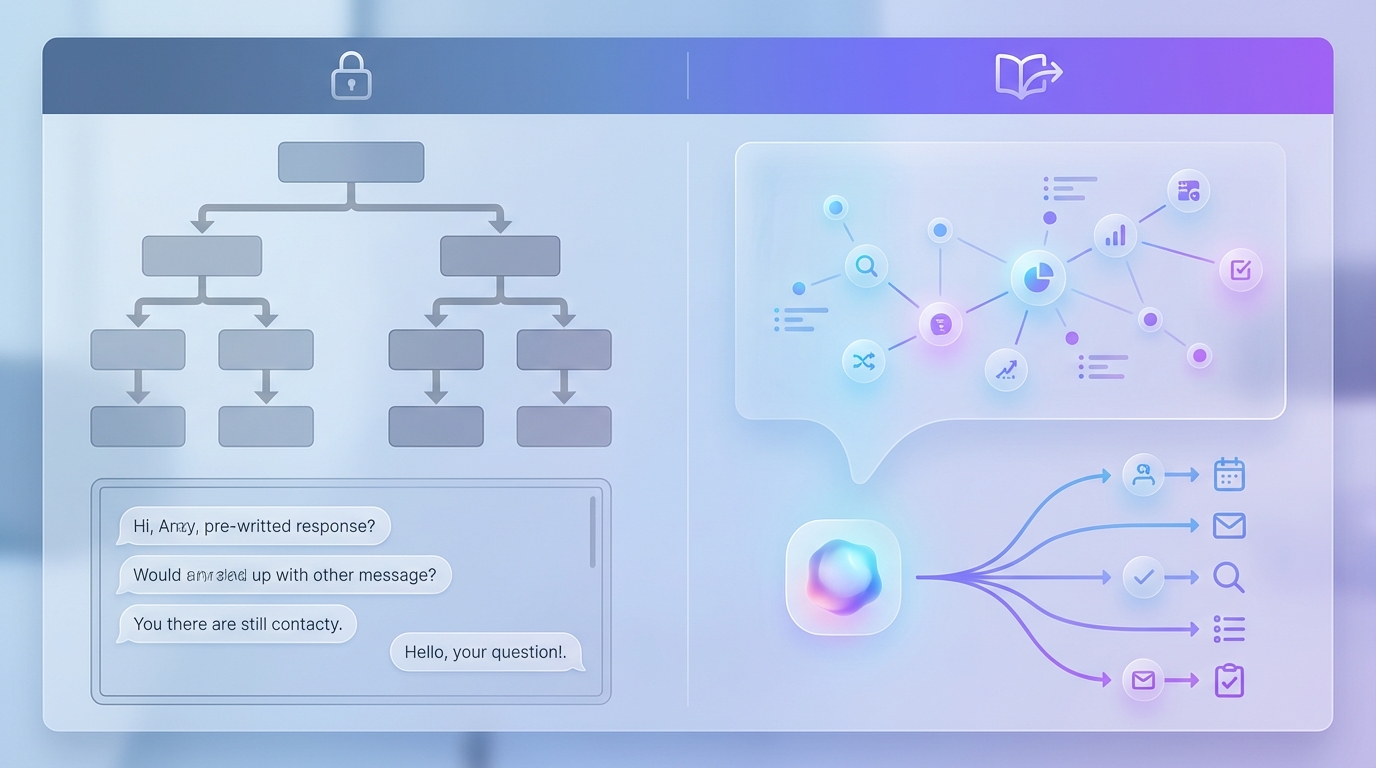 Decision Trees vs Agentic AI
To appreciate the architecture of a 2026 ai chatbots for customer service, we must first post-mortem the failure of the previous generation. Early chatbots operated on rigid state machines and deterministic decision trees. They were effectively glorified FAQs masked behind a conversational UI.
The Problem with Deterministic Trees
Imagine a user types: "I need to upgrade my enterprise plan, but my billing credit card expired yesterday, and I need access to the API module before close of business."
A 2022 deterministic bot scans for a keyword. It might trigger on "upgrade" and push the user to an irrelevant pricing tier link. Or it might trigger on "billing" and push the user to a generic knowledge base article on how to change a credit card. Neither resolves the complex, urgent, multi-faceted intent of the user. Frustrated, the user types "speak to a human," entirely defeating the purpose of the automation.
Legacy bots break the moment a user deviates from the developer's exact preconceived path. They lack semantic understanding, contextual memory, and the physical capability to act across disparate backend systems.
As outlined in our guide on Automated Customer Support AI, resolving these multi-step friction points requires an infinitely flexible solution. This is precisely why the market has abandoned linear bots.
2. Key Features of a 2026 AI Chatbot
The modern chatbot for website platforms, often labeled as "Copilots" or "Agentic Assistants", operate on entirely different underlying physics. Top-tier tools like LeadAdvisor AI do not rely on pre-written responses. They generate dialogue dynamically in real-time. Here are the defining features of systems built in 2026:
A. LLM-Powered Semantic Intent Engine
When a user inputs a query, the AI does not look for exact keyword matches. Instead, it utilizes an embedding model to map the input onto a high-dimensional vector space, capturing the semantic meaning of the text. Even if the user uses slang, typos, or highly technical industry jargon, the AI grasps the profound underlying intent. It understands the difference between a casual browser and an angry customer seeking a refund.
B. Multi-Turn Context and Infinite Memory
In human conversation, memory is vital. If your prospect says, "Those analytics features look great," and then two minutes later asks, "Does it integrate with Salesforce?", an intelligent agent knows "it" refers to the analytics module previously discussed. A 2026 chatbot retains full conversational history across the session, allowing for deep, multi-turn negotiations and complex problem-solving without ever forcing the user to repeat themselves.
C. Native Tool Use (Function Calling)
This is the most critical advancement. A chatbot is useless if it only talks. The best chatbots for customer service utilize "function calling." They can execute API requests autonomously.
- For Sales: The bot checks a Sales Rep's live calendar, books a slot, and creates the Salesforce Opportunity record.
- For Support: The bot authenticates the user, checks the live inventory database or Stripe billing portal, processes a refund, and automatically extends their subscription tier.
The AI takes the action rather than just providing the information. For more on implementing proactive support architectures, consult our deep dive How to Automate Support.
D. Zero-Day Training via RAG (Retrieval-Augmented Generation)
You no longer have to manually type out hundreds of rules. You point the AI to your public website, your internal Zendesk articles, your Notion wikis, and your historical Slack channels. The AI ingests this data, often millions of words, in minutes. When asked a question, it retrieves the precise document, reads it, and synthesizes a direct, perfectly natural answer tailored to the specific user inquiry.
3. Step-by-Step Implementation Guide
Deploying customer support chat bots that operate as true revenue engines requires strategic alignment. Here is the blueprint for launching a successful 2026 generative AI bot in 30 days:
Phase 1: Audit and Knowledge Aggregation (Days 1-7)
The intelligence of your bot is strictly bound by the quality of the data it ingests.
- Map the User Journey: Identify the top 20 actions users take on your website (e.g., booking a demo, resetting a password, finding API docs).
- Consolidate the Corpus: Gather every PDF battle card, every help center article, and current API documentation.
- Cleanse the Data: Remove outdated pricing sheets or legacy product guides to prevent the AI from serving inaccurate data.
Phase 2: Platform Integration and Prompt Engineering (Days 8-14)
Selecting the right platform is critical. You need an architecture that supports enterprise-grade RAG and secure API endpoints.
- Define the Persona: Prompt the bot to reflect your brand's voice. A cybersecurity firm's bot must sound clinical and authoritative; an e-commerce fashion bot can be casual and emoji-friendly.
- Establish Guardrails: Strictly define what the bot cannot do. For example: "Under no circumstances should you offer a discount greater than 20% or process a cancellation without generating a retention ticket first."
- Connect Tools: Integrate OAuth flows so the bot can securely perform actions on behalf of a logged-in user.
Phase 3: The "Shadow Mode" Launch & Human-in-the-Loop (Days 15-21)
Do not launch a generative AI blindly to 100% of your traffic.
- Internal Testing: Have your SDRs and Support teams adversarial-test the bot ("red-teaming"). Try to force it to hallucinate or break its guardrails.
- Soft Launch: Deploy the widget to just 5% of web traffic. Monitor the transcripts live.
- Human-in-the-Loop (HITL): Ensure seamless escalation. If the AI detects high frustration (sentiment analysis drops) or cannot resolve the query within three turns, it must smoothly handover to a human agent, passing the entire transcript context so the user doesn't have to repeat themselves.
Phase 4: Scaling and Optimization (Days 22-30)
- Analyze Unresolved Queries: Look at where the bot escalated to a human. This highlights gaps in your knowledge base. Add the missing information, and the bot learns instantly.
- Expand Use Cases: Move from purely reactive customer service to proactive outbound engagement.
4. Measuring Success: CSAT, ROI, and Deflection Rates
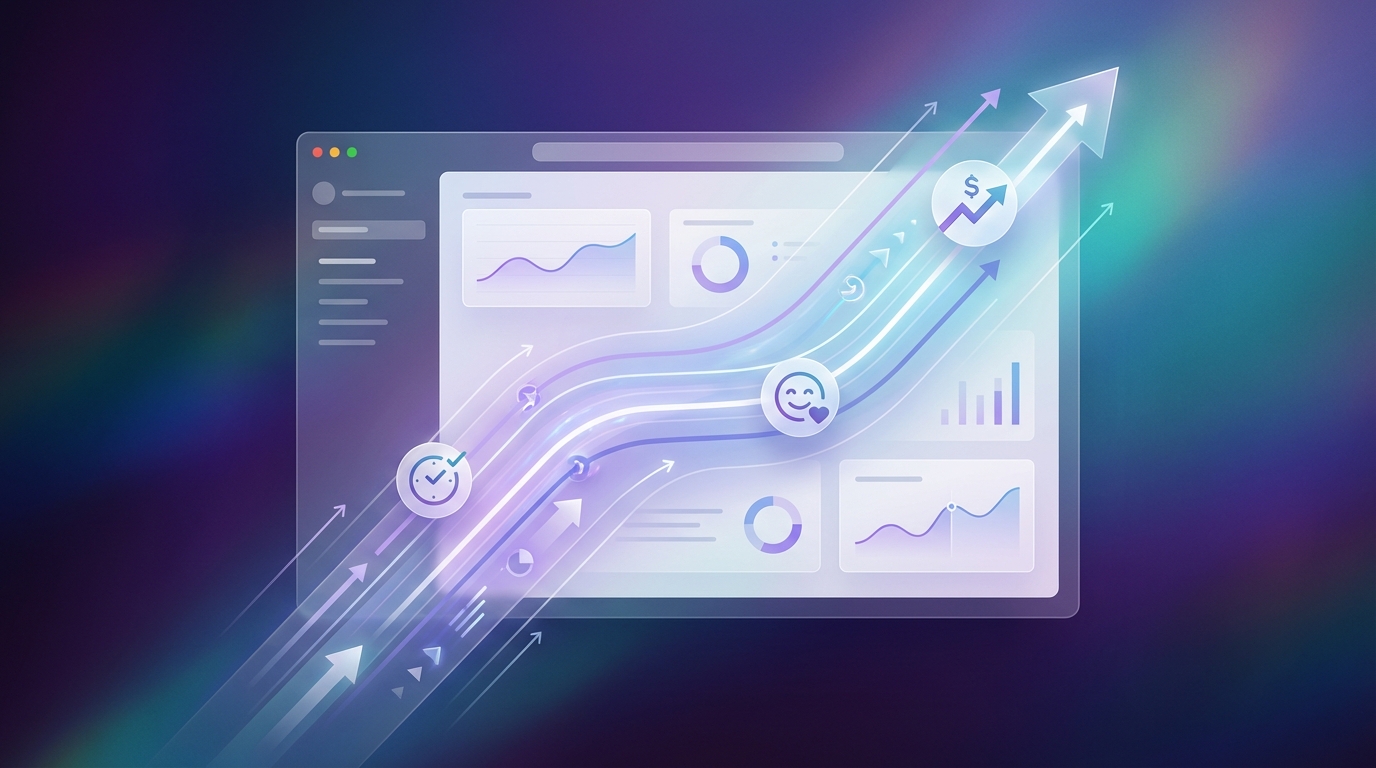 AI Driving Support and Revenue Metrics
You cannot manage what you do not measure. A state-of-the-art ai chatbots for customer service deployment impacts both the top and bottom lines. In 2026, enterprise teams track absolute impact across these core KPI pillars:
A. Deflection Rate (The Primary Support Metric)
Deflection rate measures the percentage of user inquiries successfully resolved by the AI without requiring a human touch. In 2022, a 15% deflection rate was considered successful. Today, with LLMs, organizations routinely hit 60% to 80% deflection rates on tier-1 and tier-2 support tickets. This mathematically equates to massive headcount savings and reduced wait times.
B. Customer Satisfaction (CSAT) and First Contact Resolution (FCR)
Users do not actually want to talk to humans; they want their problems solved immediately. When an AI bot can instantly query a database, locate a lost package, and automatically issue a replacement order at 3:00 AM on a Sunday, CSAT scores skyrocket. Track your CSAT specifically segmented to users who interacted only with the bot versus those who required human escalation.
C. Pipeline Generated (The Sales Metric)
The ultimate measure of a modern digital agent is its ability to generate revenue. Track the number of Net New Meetings booked by the bot, the amount of intent captured, and the conversion rate of anonymous web traffic to qualified CRM leads. For a deeper look into the sales-specific ROI metrics, review our breakdown on Conversational AI for Lead Capture.
D. Time-to-Resolution (TTR)
Compare the average resolution time of an AI-handled case (typically seconds) versus the historical average of human-handled cases (often hours or days).
Conclusion: LeadAdvisor AI and the Future of Engagement
The difference between a website that functions as a static digital brochure and one that operates as a relentless, intelligent growth engine comes down to the quality of your conversational interface.
The legacy approach of deterministic, rule-based chatbots is fundamentally incompatible with the demands of the 2026 consumer. The buyers and users of today demand contextual intelligence, instant action, and frictionless problem solving.
LeadAdvisor AI provides the foundational infrastructure required to build and deploy these sophisticated ai chatbots for customer service and sales. By leveraging top-tier large language models, proprietary security guardrails, and deep native tool integrations, we empower enterprises to transform their websites into highly capable, autonomous digital workforces.
Stop settling for frustrating decision trees. Elevate your brand experience, automate your operational overhead, and capture more revenue.
If you are ready to architect your 2026 website experience, explore how autonomous agents are defining the future of business in our guide to The Future of AI Sales.