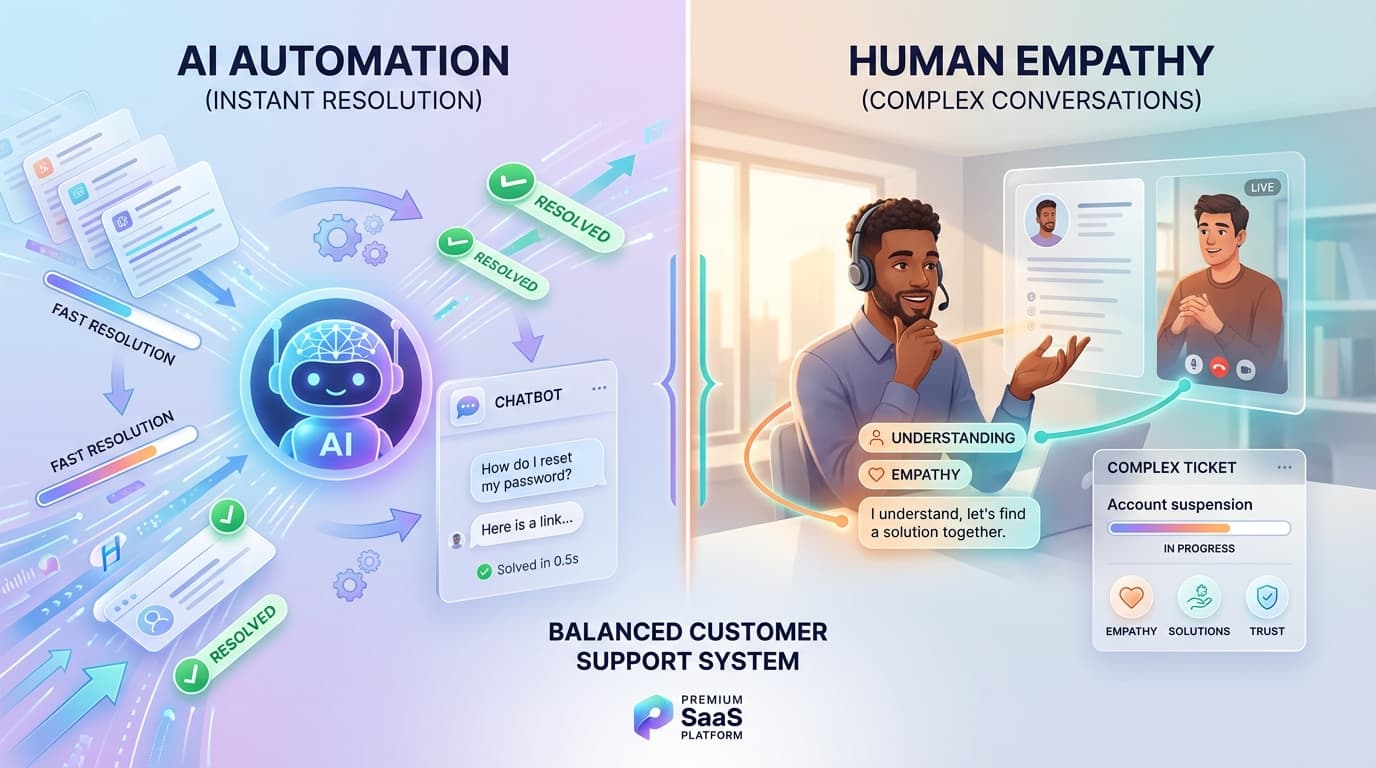
Automated Customer Support: Balancing AI Efficiency with Human Empathy
Automated Customer Support: Balancing AI Efficiency with Human Empathy
In the world of B2B SaaS, Customer Experience (CX) is the battleground where churn is either prevented or accelerated. When a user encounters a bug, gets stuck during onboarding, or needs help understanding a billing invoice, their frustration level is high. Their expectation for a rapid, accurate resolution is even higher.
For years, companies faced a brutal dichotomy: either hire massive armies of support agents to ensure fast response times (which destroys profit margins), or rely on cheap, frustrating offshore support and clunky decision-tree chatbots (which destroys customer loyalty).
The advent of Large Language Models (LLMs) and advanced Conversational AI has finally broken this paradigm. In 2026, Automated AI Customer Support allows companies to deflect up to 80% of routine tickets instantly while reserving human empathy for the complex, high-stakes interactions that truly matter.
This guide explores how to perfectly balance the ruthless efficiency of AI with the nuanced empathy of human support teams.
1. The Anatomy of a Support Queue
To understand where AI excels, we must dissect the typical B2B support queue. In almost every SaaS company, ticket volume follows a Pareto distribution (the 80/20 rule).
The 80%: Routine, Knowledge-Based Queries
- "How do I reset my password?"
- "Where can I find my API key?"
- "Can I add another seat to my plan?"
- "Does your platform integrate with Slack?"
These queries do not require empathy; they require speed and accuracy. The customer is not looking for a shoulder to cry on; they are looking for a link to the documentation.
The 20%: Complex, Emotional, or High-Stakes Queries
- "Your system crashed during our Black Friday launch and we are losing thousands of dollars."
- "I don't understand why my bill is twice as high this month."
- "I've tried following the API docs but I'm getting a 500 error on the webhook payload."
These queries require deep investigation, nuanced communication, and most importantly, human empathy. When a customer is angry or facing an edge-case technical bug, an automated response—no matter how accurate—can often feel dismissive.
2. Deploying AI for the 80% (Deflection without Frustration)
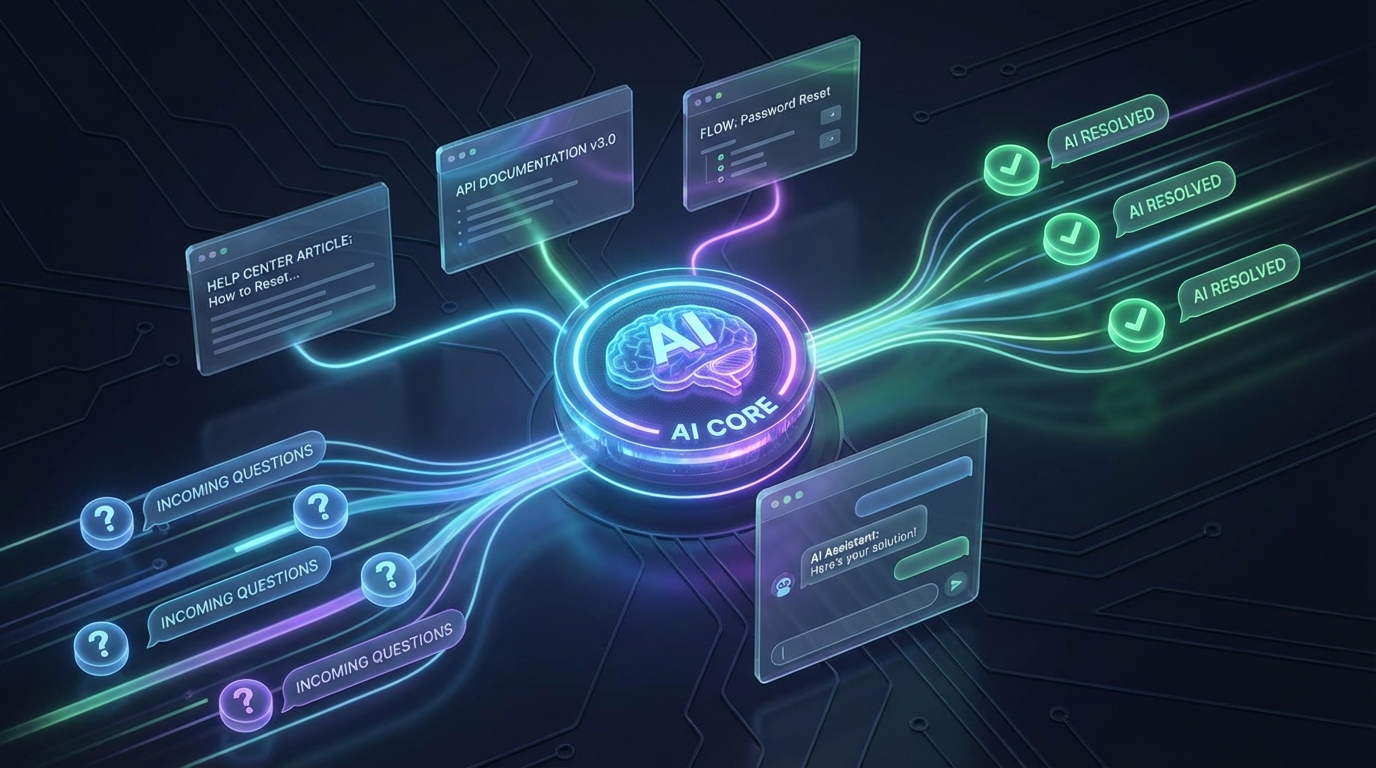 AI Deflecting Routine Support Tickets
The goal of AI in customer support is ticket deflection: resolving the customer's issue before it ever reaches a human agent's Zendesk or Intercom inbox.
Ingesting the Source of Truth
Modern AI support agents (like LeadAdvisor AI's support modules) are incredibly effective because they are built on Retrieval-Augmented Generation (RAG). You do not manually program answers into these bots. Instead, you point the AI at your existing Zendesk Help Center, Notion wikis, API documentation, and past resolved tickets.
The AI creates a vector database of your entire company's knowledge. When a customer asks, "How do I export my data to a CSV?", the AI reads the query, retrieves the exact documentation regarding CSV exports, and drafts a conversational, easy-to-read response instantly.
The Power of Multilingual Support
If you have a global user base, supporting customers outside of English traditionally requires hiring specialized bilingual agents or utilizing slow translation plugins. AI natively understands and generates in over 50 languages. A user in Brazil can ask a question in Portuguese, and the AI will read your English documentation, instantly translate the concept, and reply in fluent, idiomatic Portuguese.
Zero Wait Times = High CSAT
The primary driver of low Customer Satisfaction (CSAT) scores is wait time. When an AI instantly resolves a routine question, the CSAT score invariably spikes, because the customer receives their answer with zero friction.
3. The Human-in-the-Loop Protocol
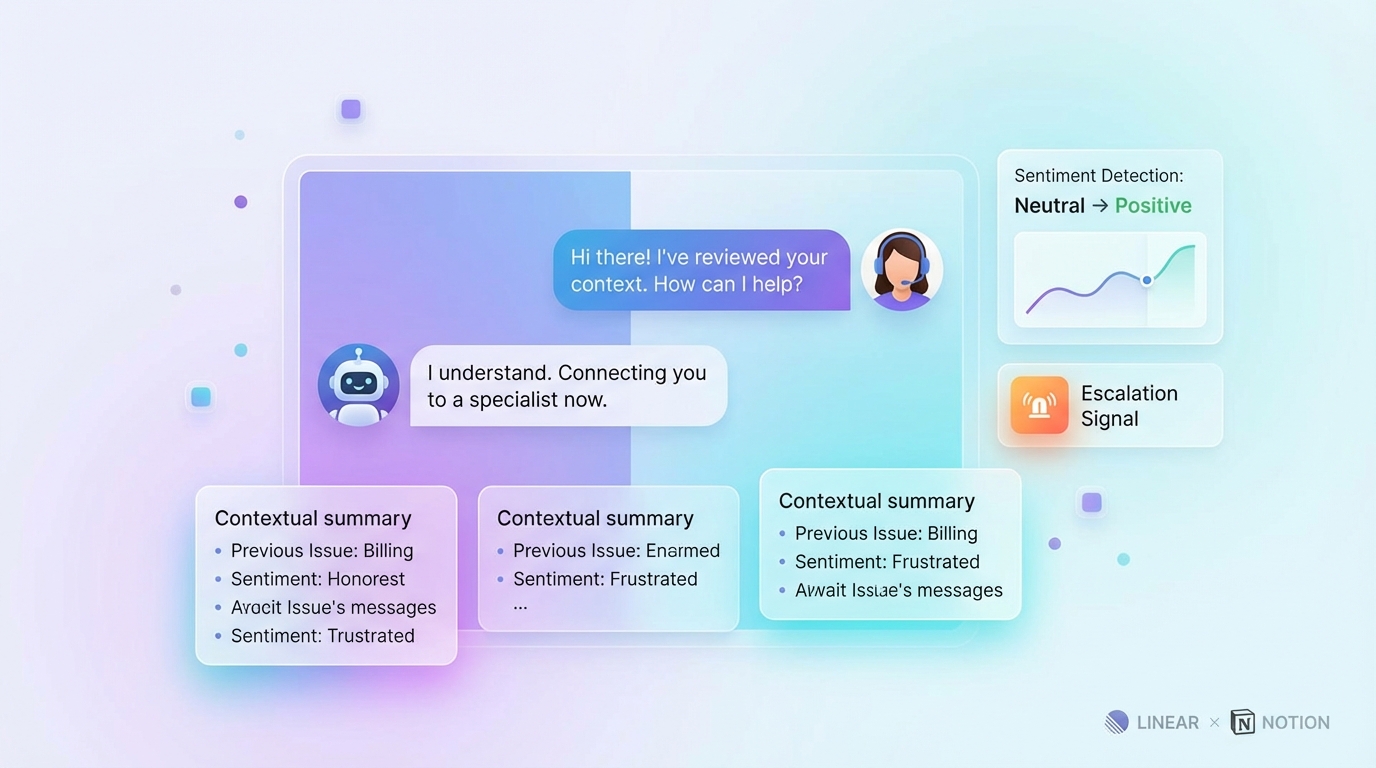 Human-in-the-Loop Support Handoff
The biggest mistake companies make is viewing AI as a total replacement for human agents rather than a sophisticated triage layer.
If an AI cannot resolve a query, or if the customer is visibly frustrated, the system must engage a "Human-in-the-Loop" (HITL) protocol. The handoff between AI and human must be seamless.
Sentiment Analysis Triggers
Advanced AI can detect sentiment. If a user types, "This is the third time I've asked this and I'm extremely frustrated," the AI should not attempt another automated response. It should instantly trigger a routing rule: flag the chat as "High Priority/Negative Sentiment" and route it to a Tier 2 human agent.
The Contextual Handoff
When a human agent takes over a chat, they should never start with: "Hi, how can I help you today?" This forces the customer to repeat everything they just told the AI, which is infuriating.
Instead, the human agent receives a summarized brief from the AI: Context: User is trying to integrate the Slack app. They have authenticated successfully but are failing to receive webhook events. I provided the standard troubleshooting guide, but they are still stuck.
The human agent can then step in smoothly: "Hi Sarah, I see you're struggling with the Slack webhook events after authentication. Let me pull up your account logs and take a deeper look at the payload drops."
This creates a seamless, white-glove experience.
4. Elevating the Role of the Human Agent
By offloading the repetitive 80% of tickets to the AI, what happens to your human support team? They transform from reactive data-entry clerks into proactive Customer Success Managers.
Solving the Root Causes
When agents aren't spending 6 hours a day copying and pasting password reset instructions, they have time to conduct deep root-cause analyses. Why are the other 20% of tickets occurring? Agents can work directly with the Product and Engineering teams to fix UX flaws, thereby permanently reducing ticket volume.
White-Glove Onboarding
Human agents can transition their available bandwidth into proactive outreach. They can hop on Zoom calls with high-paying Enterprise clients to ensure their onboarding is flawless, drastically improving retention rates and Net Revenue Retention (NRR).
Training the AI
The human agent becomes the manager of the AI. When a human resolves a novel edge-case ticket, they document the solution and feed it back into the AI’s knowledge base. The AI learns from the human, ensuring that it can handle that specific issue autonomously the next time it arises.
5. Security and Hallucination Mitigation
A common fear regarding AI in support is "hallucinations"—the AI confidently providing incorrect information, such as promising a refund policy that doesn't exist or suggesting a non-existent product feature.
To balance efficiency with safety, modern support architectures implement strict guardrails:
- Strict Context Boundaries: The AI is instructed via its system prompt: "You may only answer questions based on the provided documentation. If the answer is not in the documentation, you must say 'I don't have that exact information, let me connect you with a human expert.'"
- Action Limitations: While an AI can guide a user on how to delete their account, it should not have the API permissions to actually execute a destructive action on a database without human oversight.
6. The Future is Collaborative
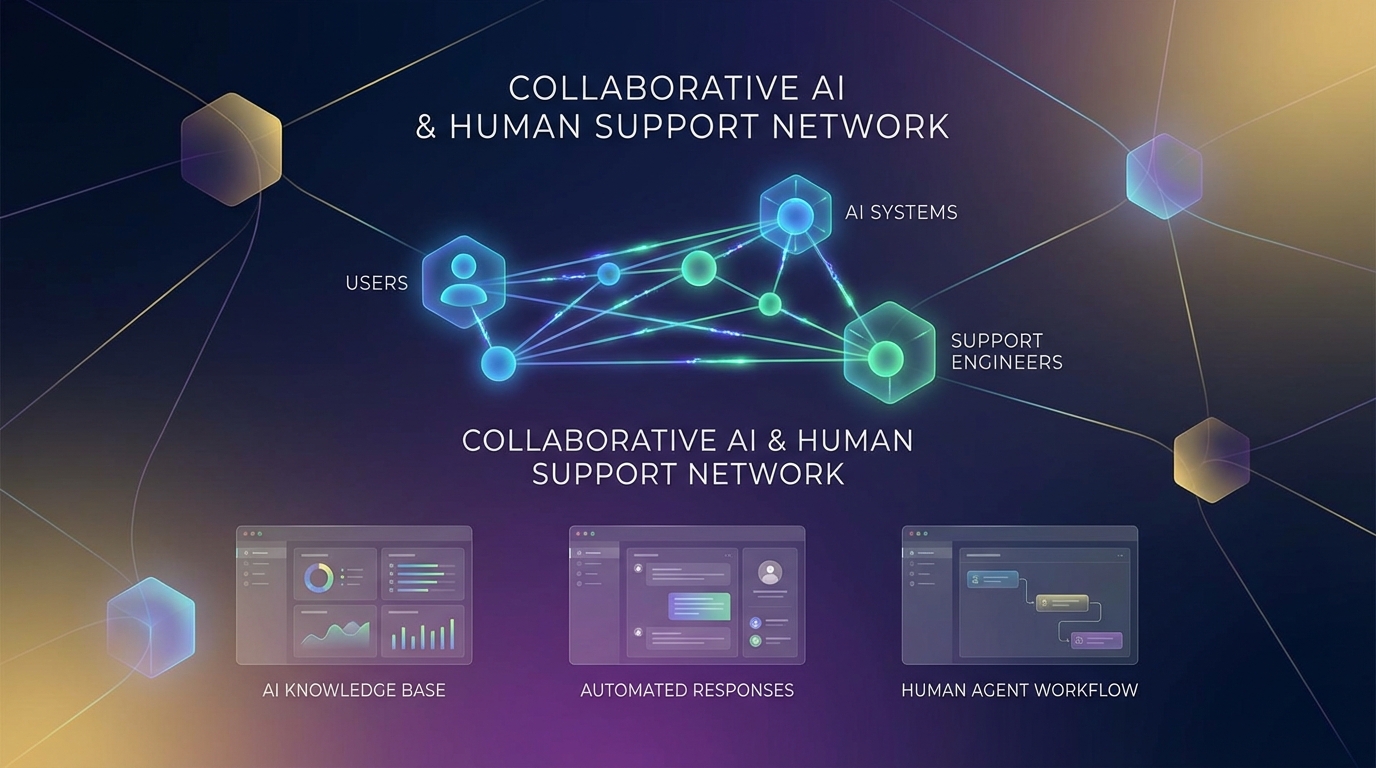 AI Human Collaborative Support Ecosystem
The future of customer support is not human versus AI; it is human augmented by AI.
When a B2B SaaS company gets this architecture right, the results are transformative. Support costs decrease significantly as ticket deflection rises. CSAT scores improve because wait times are eliminated for routine queries. And most importantly, human agents report higher job satisfaction because they are engaging in complex, meaningful problem-solving rather than rote repetition.
Automated AI support is no longer a futuristic concept—it is the baseline expectation for the modern B2B buyer. Balancing its ruthless efficiency with the deeply human capacity for empathy is the ultimate playbook for scaling a world-class customer experience in 2026.