Beyond ChatGPT: Why Specialized AI Agents Are the Future of B2B
Beyond ChatGPT: Why Specialized AI Agents Are the Future of B2B
When ChatGPT launched to the public, it irreversibly changed the trajectory of the modern business landscape. For the first time, professionals could interact with a machine using natural language and receive highly coherent, conceptually advanced responses. It was an inflection point for artificial intelligence, sparking a wave of enterprise adoption. Yet, as business leaders transition from the "exploration phase" into full-scale implementation in 2026, a critical realization is emerging: a generalized conversational interface is not enough to run a revenue engine.
While a general-purpose Large Language Model (LLM) is excellent at drafting an email template, brainstorming marketing copy, or summarizing PDF documents, B2B organizations are increasingly asking a much more complex question: "Is there a better AI than ChatGPT for actual business execution?"
The answer is unequivocally yes.
As the limitations of one-size-fits-all models become apparent, specifically regarding enterprise security, hallucination rates, and the inability to take independent action, the market is pivoting. The search for true ChatGPT alternatives is no longer just about finding another conversational bot; it is about finding specialized, autonomous agents capable of executing complex B2B workflows.
In this deep dive, we will explore the critical limitations of generalized LLMs in the enterprise space, the explosive rise of specialized "Action Agents" (also known as Agentic AI), and how tailored solutions like LeadAdvisor AI are entirely redefining what it means to automate B2B growth.
1. The Limitations of General-Purpose LLMs for Business
To understand the shift toward specialized agents, we must first analyze the structural constraints of general-purpose AI platforms. Tools like ChatGPT, Claude, and Gemini are undeniably powerful, but they operate by design as wide-net intelligence engines. They know a little bit about quantum physics, 14th-century poetry, and writing Python scripts, but they do not inherently know your product's unique value proposition, your complex enterprise pricing tiers, or your specific sales methodology.
The "Stochastic Parrot" Problem and Context Scarcity
A generalized LLM generates text by predicting the most statistically probable next word based on its massive, generalized training data. While this produces articulate text, it lacks deep, localized context. In a B2B sales environment, nuance is everything.
If a prospect asks, "How does your edge-routing protocol compare to Cisco's mid-market offering?", a generalist AI might hallucinate an answer based on outdated internet data, or simply state that it cannot provide a definitive comparison. This is useless for closing deals. A B2B solution requires deep, bounded knowledge specific to your domain, ensuring that every response perfectly aligns with your competitive battle cards.
If you are looking for an AI like ChatGPT to run your sales floor, you are essentially looking for an encyclopedic librarian when what you actually need is a highly trained, quota-carrying Account Executive.
Requiring Constant Human Prompts
The fundamental architecture of a generalized chat model is reactive. It waits constantly for a human to type a prompt. It acts as an assistant, not as an autonomous worker.
In a high-velocity B2B environment, such as scaling inbound lead qualification or executing an outbound account-based marketing (ABM) strategy, relying on a human to constantly prompt the AI defeats the purpose of automation. Your sales team becomes a team of "AI Operators" rather than closers. The true value of AI in 2026 lies in autonomy, which brings us to the next critical limitation.
For a broader perspective on the economics of autonomous vs. human labor, see our comprehensive breakdown on AI SDR vs Human SDR ROI.
2. Security, Privacy, and Hallucination Concerns
When evaluating ChatGPT competitors, enterprise IT and compliance teams are driving the conversation just as much as Revenue teams. The risks associated with feeding proprietary company data or sensitive customer PII into public AI models have led many Fortune 500 companies to ban general LLMs outright.
The Hallucination Liability
In a casual brainstorming session, an AI hallucination, inventing a fake fact or citing a non-existent source, is a minor inconvenience. In an enterprise sales environment, it is a massive liability.
If an AI chatbot tells a prospective enterprise client that your software is fully HIPAA compliant when it is actually only SOC2 compliant, your company is now legally exposed. General LLMs have an intrinsic "creativity" parameter that allows them to invent plausible-sounding answers when they lack hard facts. Specialized B2B AI agents are fundamentally engineered differently. They utilize Retrieval-Augmented Generation (RAG) and strict systemic guardrails. If a specialized agent does not explicitly know the answer, it is programmed to execute a graceful handoff to a human rather than invent a lie.
Data Sovereignty and PII Leakage
When your sales reps use public LLM interfaces to refine emails or summarize call notes, that proprietary data often becomes part of the AI's future training corpus. This means your private pricing negotiations could technically surface in a competitor's query.
Top-tier enterprise AI solutions operate on ring-fenced infrastructure. The data ingested by the AI, from your CRM, your internal wikis, and your historical Slack channels, is strictly siloed. It trains your specific agent, and only your agent. This zero-data-retention policy is a non-negotiable requirement for modern B2B AI implementations.
3. The Rise of Specialized "Action Agents" (Agentic AI)
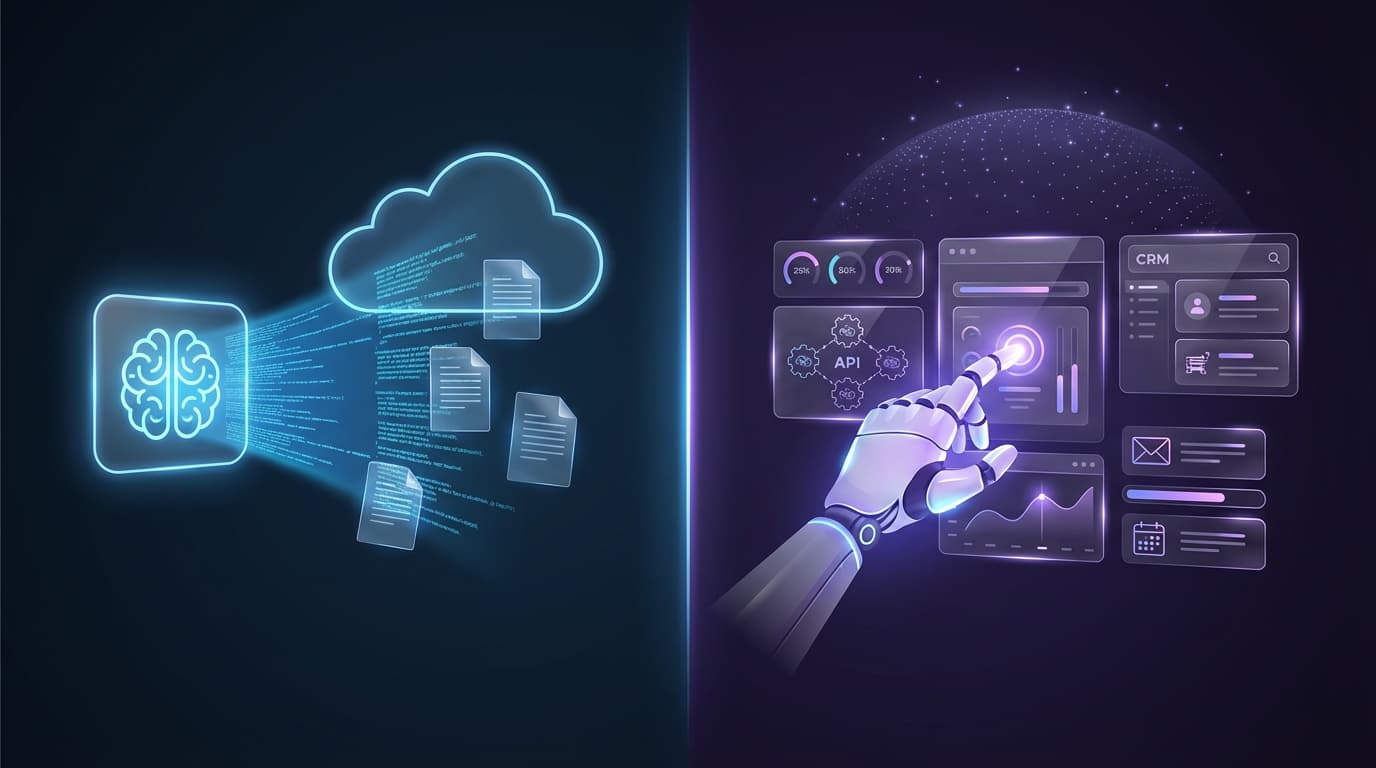
If general AI is the "brain," then Agentic AI constitutes the "hands."
The shift from Conversational AI to Agentic AI is the defining technological leap of our era. A generalized conversational AI answers questions. An Agentic AI takes action to achieve an objective. When users search for "is there a better AI than ChatGPT?", what they fundamentally desire is an AI that executes multi-step workflows autonomously.
Decoupling Conversation from Execution
Consider a typical B2B workflow: A high-value prospect visits your pricing page, asks a complex technical question about API rate limits, and then requests a demo.
A General Chatbot (or Legacy AI): Answers the question based on a static FAQ document and provides a link to a generic Calendly page. The prospect may or may not book it.
An Action Agent (Agentic AI):
- Answers the technical question precisely by retrieving real-time data from your developer documentation.
- Identifies the IP address of the user and queries your CRM (Salesforce or HubSpot) to see if this is an existing target account.
- Notices the account is currently owned by an Enterprise AE named Michael.
- Proactively suggests a meeting time by cross-referencing Michael's live Google Calendar.
- Books the meeting, creates an Event in Salesforce, logs the transcript, and sends a notification via Slack to Michael, briefing him on the technical intent of the prospect.
This entire sequence happens autonomously in milliseconds. The AI does not just talk; it acts. The technology powering these specialized agents utilizes complex planning algorithms, working memory, and real-time tool use (API integrations). They are engineered to navigate friction, handle objections, and drive toward a specific KPI, in this case, pipeline generation.
For a deeper dive into how this looks in practice for high-growth companies, read our guide on AI Sales Agents for B2B Startups.
4. How LeadAdvisor AI Fits Into This Landscape
As the market matures, the demand for hyper-specialized, enterprise-grade chatgpt alternatives in the sales vertical has skyrocketed. Businesses do not want a generic bot; they want an autonomous revenue engine.
This is precisely where LeadAdvisor AI thrives. We built our platform specifically to bridge the gap between abstract AI intelligence and tangible B2B sales execution.
Why LeadAdvisor AI is Not Just "Another Chatbot"
When comparing LeadAdvisor AI to off-the-shelf general LLM wrappers or legacy deterministic chatbots, several core differentiators emerge:
1. Purpose-Built for Revenue Operations
LeadAdvisor AI is trained natively on B2B sales methodologies. It understands the difference between a gatekeeper and a decision-maker. It knows how to interpret buying intent signals, navigate complex budgeting objections, and push for a commitment. It is not an assistant; it is a B2B AI SDR designed exclusively to turn traffic and cold leads into highly qualified pipeline.
2. Total Ecosystem Orchestration
Our AI agents do not live in a siloed chat window. They integrate deeply into the fabric of your existing RevOps stack. Whether executing an outbound sequence via email, engaging a VIP account on LinkedIn, or capturing intent directly on your website, the AI connects the touchpoints. It updates Salesforce in real-time, qualifies leads against your specific Ideal Customer Profile (ICP), and routes the hottest prospects directly to human closers.
For an extensive look at how these systems orchestrate the full funnel, explore The Complete Guide to B2B AI SDRs.
3. Enterprise-Grade Guardrails and Deterministic Reliability
We understand that B2B brands cannot risk reputational damage from "hallucinating" AI. LeadAdvisor AI employs a proprietary grounding architecture. Our agents will only speak to the data you explicitly provide: be it your battle cards, knowledge base, or historical win-loss transcripts. Furthermore, the platform features highly calibrated human-in-the-loop (HITL) handoff protocols. If a prospect's inquiry exceeds the agent's permission boundaries, the AI instantly bridges the conversation to a live human rep without breaking the user experience.
5. The Verdict: Moving from Talk to Action
The era of being impressed simply because a machine can string together a coherent sentence is over. The novelty has faded, replaced by a rigorous demand for ROI, measurable efficiency, and verifiable business value.
When you search for tools similar to ChatGPT, you must redefine your criteria. A true alternative is not a slightly cheaper or slightly faster text generator. A true alternative is a system that solves the fundamental problems of your business: scaling top-of-funnel activity, drastically reducing customer acquisition cost (CAC), and operating flawlessly without constant human supervision.
The future of B2B does not belong to companies that use AI just to draft better emails. It belongs to companies that deploy specialized, autonomous intelligence directly into their revenue workflows. The future does not just talk; it acts.
If you are ready to move beyond generalized chatbots and deploy a powerful, autonomous revenue engine, it is time to explore LeadAdvisor AI. Stop waiting for prospects to navigate your generalized AI wrappers, and start engaging them with an elite digital sales team that works 24/7/365.
To see how specialized AI is fundamentally altering the trajectory of outbound strategies, read our analysis on The Future of AI Sales and discover how autonomous agents are securing the modern pipeline.