
Agentic AI vs. Generative AI: Why 'Generation' Isn't Enough for Revenue
Agentic AI vs. Generative AI: Why 'Generation' Isn't Enough for Revenue
The technological discourse of the last twenty-four months has been utterly dominated by two letters: AI. But as enterprise teams move from pilot programs to full-scale deployment in 2026, a fundamental distinction is ripping the software industry in half.
Business leaders are no longer asking if they should use artificial intelligence. They are asking: "What is agentic AI versus generative AI, and which one actually drives revenue?"
To answer that question, we must look past the buzzwords. Producing a beautifully written Shakespearean sonnet about your SaaS product takes intelligence. Executing a multi-channel outbound sequence, navigating a pricing objection from a Chief Procurement Officer, and booking a meeting on a Saturday night requires autonomy.
This is the core difference. Generative AI is the "Brain." Agentic AI comprises the "Hands."
In this comprehensive analysis, we will deconstruct the architectural differences between generative text models and autonomous agents, explore the classic chatbot vs conversational ai debate, and detail exactly why generation is no longer enough to win in modern B2B sales and support.
1. Defining Generative AI: The "Brain"
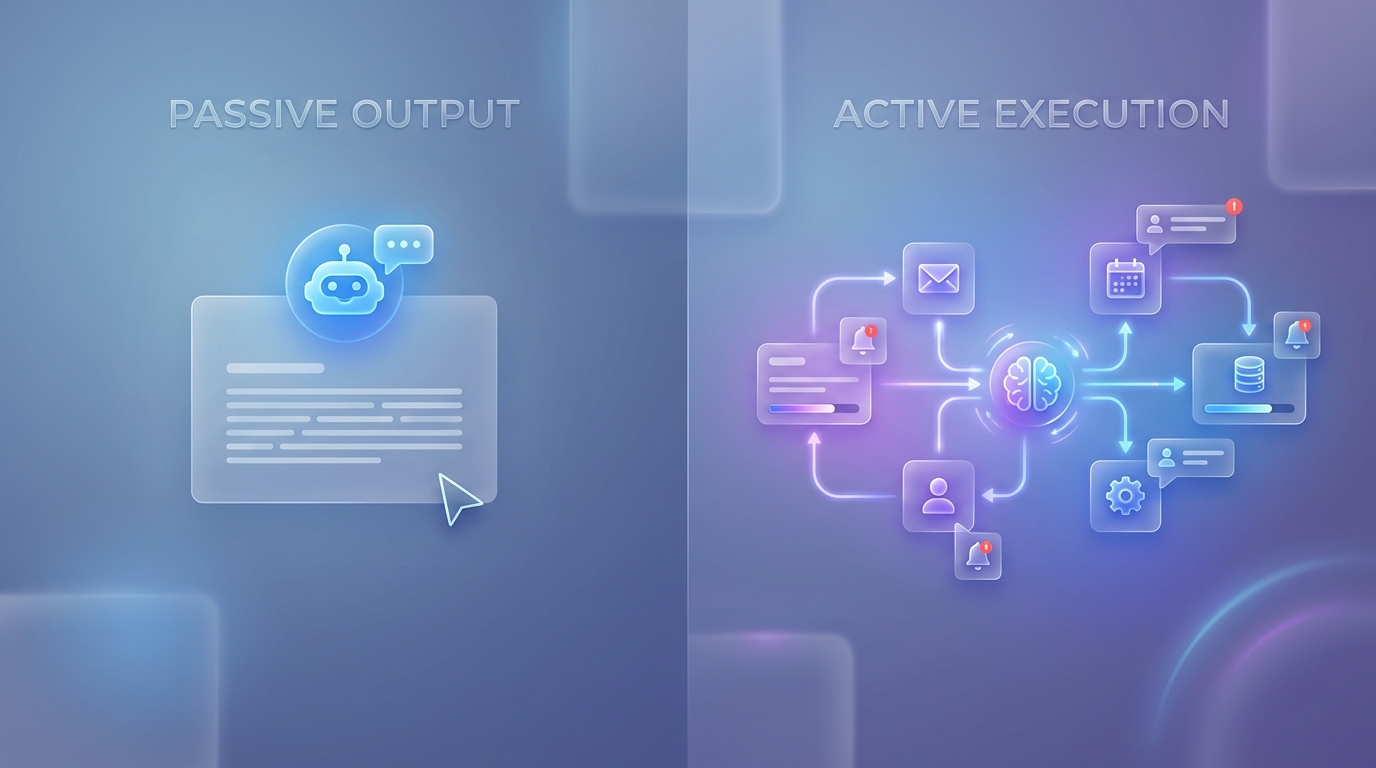 Static Output vs Autonomous System
Generative AI (GenAI) encompasses the deep learning models designed to create new content based on patterns learned from vast datasets. The most famous examples are Large Language Models (LLMs) like GPT-4, Claude, or Gemini.
How Generative AI Operates
At its mathematical core, an LLM is a prediction engine. When you provide it with a prompt, it calculates the highest probability for the sequence of words that should follow. If you ask a Generative AI: "Write a follow-up email to a prospect who missed our demo yesterday," it will instantly produce a highly articulate, grammatically flawless email template.
The Enterprise Value (and Limitations) of GenAI
Generative AI solved the problem of articulation. It allowed computers to speak and write like highly educated humans. In marketing, it revolutionized content creation. In legal, it accelerated contract summarization.
However, Generative AI is fundamentally reactive. It operates in a passive state until a human hits "Enter." It does not know who the prospect is in the CRM. It cannot check if the prospect rescheduled on a calendar. It cannot physically send the email.
If your company attempts to run its revenue engine relying solely on Generative AI, your human sales team simply transitions into becoming "prompt engineers" for the bot. The manual labor shifts from writing the email to copy-pasting the AI's email into your CRM. You have not achieved autonomy; you have merely built a faster typewriter.
2. Defining Agentic AI: The "Hands"
 Execution at Scale
Agentic AI, or Action Agents, represents the graduation of artificial intelligence from a passive assistant to an autonomous digital worker.
If someone asks what is agentic ai versus generative ai, the most accurate analogy is hiring a consultant versus hiring an employee.
- The GenAI Consultant: Provides brilliant advice, writes out a perfect strategy, and leaves the document on your desk. You have to execute it.
- The Agentic AI Employee: Reads the strategy, logs into the necessary software platforms, executes the workflow, tracks the response, handles objections, and sends you a Slack message when a deal is closed.
The Defining Characteristic: Agency
Agentic AI systems utilize Generative LLMs as their core reasoning engine (their brain), but they are wrapped in complex architectures that grant them agency, the ability to plan, act, and interact with external environments to achieve a specific goal without human supervision.
This shift entirely redefines the economics of scaling a B2B startup. When your AI can execute actions, you are no longer constrained by human headcount limits. For further reading on this economic shift, see AI Sales Agents for B2B Startups.
3. Why "Generation" Isn't Enough for Sales and Support
To understand why the enterprise market is fiercely pivoting toward Action Agents, we must look at how legacy B2B workflows actually function in the wild.
The Chatbot vs. Conversational AI Divide
A helpful way to frame this shift is the evolution of the website interface.
The Deterministic Chatbot (Pre-2022): You click a bubble. It gives you three buttons. If your problem isn't one of those three buttons, it traps you in a frustrating loop. It possesses zero intelligence.
The Generative "Conversational AI" (2023-2024): A company plugs an LLM into their website. The user asks, "How does your caching layer work?" The AI provides a beautiful, deeply technical response. The user asks, "Can I get a refund? I was billed twice." The Generative AI responds beautifully: "I am so sorry you were billed twice. That must be frustrating. Unfortunately, as an AI, I cannot access your billing records. Please email support@company.com."
The user is still frustrated. The friction remains.
The Agentic AI Copilot (2026): The user asks for a refund. The Agentic AI checks the user's authentication token, triggers an API call to Stripe, verifies that a duplicate concurrent charge occurred at 2:14 AM, triggers a refund API call, updates the Zendesk ticket, and replies to the user: "I see the duplicate charge from 2:14 AM. I have processed the refund directly to your Visa ending in 4112. The funds will clear in 2-3 business days. Is there anything else I can fix for you today?"
This is the power of Agency. It turns conversational interfaces into execution engines. For a step-by-step framework on deploying these systems, read How to Automate Support.
The Sales Use Case: Autonomous Outbound
In B2B outbound sales, Generative AI writes the cold email. Agentic AI executes the entire campaign.
A LeadAdvisor AI SDR operates precisely in this Agentic layer:
- Intent Detection: The Agent queries a data provider (like 6sense) to find an account showing buying intent.
- Contextual Research: The Agent reads the LinkedIn profile of the target VP of Sales.
- Cross-Referencing: The Agent queries your Salesforce instance to ensure no human rep is already working the account.
- Execution: The Agent drafts a hyper-personalized email and sends it via your marketing infrastructure.
- Objection Handling: When the VP replies ("We use a competitor"), the Agent autonomously executes a competitive battle-card play and replies, handling the objection and suggesting a 10-minute discovery call.
- Booking: The Agent routes the meeting directly onto your human closer's calendar.
This total, end-to-end orchestration is why revenue leaders are rapidly adopting true Action Agents.
4. The Architecture of an AI Agent
If an Agentic AI system can perform all of these actions autonomously, how is it actually built? The architecture of a top-tier B2B agent relies on three core pillars: Memory, Planning, and Tool Use.
1. Memory (Statefulness)
A human sales rep remembers that a prospect mentioned a vacation last week. A standard Generative AI forgets everything the moment the chat window closes.
Agentic systems are built on vector databases that provide infinite memory. They maintain conversation state. If a prospect engaged your AI via LinkedIn on Tuesday, and then visits your website chat widget on Friday, the AI remembers the entire context of the Tuesday conversation and picks up exactly where it left off.
2. Planning (Chain-of-Thought)
Complex tasks require multi-step planning. If you tell an Agentic AI to "Book a meeting with Acme Corp," the AI must execute a "Chain-of-Thought" process:
- Thought 1: I need to find the decision-maker at Acme Corp.
- Action 1: Execute LinkedIn API query for "VP Engineering at Acme."
- Thought 2: I found Sarah Jenkins. I need her email.
- Action 2: Execute Apollo.io API query for Sarah Jenkins' email.
- Thought 3: I have her email. Now I must write the message.
This internal reasoning loop allows the AI to course-correct if a step fails.
3. Tool Use (Function Calling)
As previously mentioned, Tool Use is the defining characteristic of Agency. Through secure OAuth integrations and precise API definitions, the LLM is given access to external software. It can query Salesforce, update HubSpot, send a Slack message, or check inventory levels. The AI acts as the orchestration layer between disparate software systems.
Conclusion: The Era of Execution
When evaluating technology for your B2B enterprise in 2026, understanding what is agentic ai versus generative ai is not an academic exercise. It is the core strategic decision that dictates the scalability of your organization.
Generative AI reduces the friction of creating content. Agentic AI eliminates the friction of executing complex business operations.
Organizations that settle for conversational interfaces will find themselves with highly articulate, but ultimately passive digital assistants. Organizations that implement Agentic AI will radically scale their top-line revenue, fundamentally dropping their Customer Acquisition Costs, and providing 24/7, frictionless experiences to their buyers.
LeadAdvisor AI provides the autonomous agentic infrastructure designed exclusively for B2B revenue teams. Stop paying for generation. Invest in execution.
To learn more about how intelligent, autonomous qualification systems are changing the shape of the inbound funnel, explore our analysis on AI Lead Qualification in 2026.