
The Rise of the Real Estate AI Assistant: Automating Lead Generation in 2026
The Rise of the Real Estate AI Assistant: Automating Lead Generation in 2026
The real estate industry operates on a punishing fundamental truth: speed is everything. If you are a real estate agent or a managing broker, you know the drill. You spend thousands of dollars every month buying leads from Zillow, Realtor.com, or running your own hyper-local Facebook and Google Ads campaigns. But generating a lead is only five percent of the battle. The other ninety-five percent is the absolute chaos of trying to contact that lead before a competitor does.
If you are currently relying on manual follow-ups, a fragmented Inside Sales Agent (ISA) team, or an outdated rule-based chatbot on your IDX website to capture and qualify these leads, you are actively burning your marketing budget. When a prospective homebuyer submits an inquiry on a property at 11:30 PM on a Tuesday, they expect an immediate, intelligent response. If your brokerage relies on a contact form that promises "an agent will be in touch tomorrow," that lead is already gone. They have moved on to the next listing and the next agent.
This high-stakes, hyper-competitive environment has birthed a massive technological shift: the era of the Autonomous Real Estate AI Assistant. Let's explore exactly what this technology is, why the traditional real estate chatbot is dead, and how AI agents are systematically taking over the role of the modern ISA to scale brokerages like never before.
1. The "Speed to Lead" Crisis in Real Estate
To understand why the Real Estate AI Assistant is becoming mandatory, we first have to accurately diagnose the "speed to lead" crisis that has plagued the industry for the last decade.
The MIT Lead Response Management Study famously established that the odds of contacting a lead decrease by over 100 times if an agent waits 30 minutes versus calling within the first 5 minutes. The odds of actually qualifying that lead decrease by over 21 times. In real estate, the numbers are even more brutal. A buyer inquiring about a new listing is at their peak moment of emotional intent. They are imagining themselves cooking in the kitchen; they are picturing their kids in the backyard. That emotional high has a half-life of mere minutes.
The Problem with Human ISAs
Brokerages historically tried to solve this by hiring teams of human Inside Sales Agents (ISAs). While human ISAs are incredibly valuable for relationship building, they suffer from unavoidable bottlenecks:
- Scalability: During the spring market rush, an ISA might have 50 new leads drop in a single hour. It is physically impossible for a human to call, text, or email 50 people instantly.
- Availability: Humans need to sleep. They take weekends off. They go to lunch. Real estate buyers, conversely, do a massive portion of their browsing on evenings and weekends when ISAs are typically off the clock.
- Cost: A high-performing, US-based ISA commands a significant base salary plus commission. Attrition in these roles is notoriously high due to the repetitive, high-rejection nature of calling internet leads all day.
The Problem with 'Dumb' Chatbots
When brokerages realized humans couldn't scale infinitely, they turned to software. The early 2010s saw the proliferation of the "real estate chatbot." These were glorified decision trees programmed with rigid "IF/THEN" logic.
IF user clicks 'Buy', THEN ask 'What is your budget?' IF user types anything else, THEN say 'Please leave your email and an agent will call you.'
These legacy systems failed miserably. Buying or selling a home is the largest financial transaction most people will ever make; it is an inherently emotional, nuanced, and complex process. When a high-intent buyer asked a legacy bot, "Are there any good elementary schools within walking distance of this zip code?" the bot completely broke, demanding an email address and creating immense buyer frustration.
 AI That Thinks Like an Agent
2. Enter the Autonomous Real Estate AI Assistant
In 2026, the paradigm has shifted entirely. A modern Real Estate AI Assistant—powered by advanced Large Language Models (LLMs) like the engine driving LeadAdvisor AI—does not rely on rigid flowcharts. It operates utilizing deep contextual intelligence, conversational memory, and goal-oriented reasoning.
What is Contextual Intelligence in Real Estate?
When an AI Assistant engages a visitor on your brokerage's website, Facebook Messenger, or via SMS, it comes armed with total context. Through Retrieval-Augmented Generation (RAG), the AI has ingested your entire local market data, your active listings, your brokerage's unique value propositions, and your specific pre-qualification criteria.
Imagine a scenario where a lead comes in via a Facebook ad for a luxury condo in downtown Miami at 2:00 AM.
A legacy bot would simply say: "Thanks for your interest. What is your email?"
An Autonomous Real Estate AI Assistant reasons and converses like a top-tier agent:
Buyer: "I'm looking at the luxury condo on main street but I have a golden retriever. Is the building pet friendly and does it have a balcony?" AI Assistant: "Great question! I see you're looking at the Main Street luxury units. Yes, that specific building is highly pet-friendly and features a private dog park on the 4th-floor terrace. All units above the 10th floor also include private wrap-around balconies. Are you currently pre-approved for a mortgage, or would you like me to connect you with one of our preferred local lenders before we schedule a tour?"
This incredibly complex interaction happens in milliseconds. The AI accurately diagnosed the specific property, answered highly nuanced questions regarding amenities (pets and balconies), provided localized context, and immediately seamlessly transitioned into the pre-qualification phase (asking about mortgage approval).
3. The Anatomy of a High-Converting Real Estate AI
The true power of an AI assistant lies not just in its ability to answer questions, but in its ability to drive revenue. An optimized Real Estate AI system functions as an infinitely scalable, hyper-intelligent ISR that executes a multi-phase inbound funnel flawlessly.
Phase 1: Omnichannel, Proactive Engagement
Modern buyers do not exclusively live on websites. Effective AI doesn't just sit in a chat widget; it operates across your entire digital footprint. Whether a lead sends an SMS from a yard sign rider, messages your Instagram business page, or chats on your website, the AI responds instantly.
For example, when a new lead drops into your CRM from a Zillow integration, the AI can proactively send an SMS within 5 seconds: "Hi Sarah, this is Alex, the AI assistant for the Smith Group. I saw you just favored the 4-bedroom on Elm St. The market is moving fast on that block—would you like me to find out if they are reviewing offers yet?"
Phase 2: Instant, Natural Qualification
Not every lead is ready to buy tomorrow, and not every lead is a fit for your specific real estate team. A core function of the AI assistant is protecting your top-producing human agents' time by separating the high-intent buyers from the casual "tire-kickers."
Through natural, friendly conversation, the Real Estate AI Assistant executes a customized qualification matrix. It subtly extracts critical data points:
- Timeline: (e.g., "Are you looking to move before the new school year starts?")
- Budget & Financing: (e.g., "Have you started the pre-approval process, or are you hoping to pay cash?")
- Motivation: (e.g., "Are you relocating for work, or just looking for a larger space?")
- Status: (e.g., "Do you have a home you need to sell first before buying?")
If the AI determines the lead has a home to sell, it immediately pivots to pitching a listing presentation or a comparative market analysis (CMA). If the lead is a student just looking at expensive houses for fun, it politely directs them to your newsletter, keeping your CRM clean and your agents focused.
Phase 3: Frictionless Appointment Setting
The ultimate goal of any AI assistant is to get the human agent face-to-face with a qualified prospect. The holy grail of real estate automation is frictionless scheduling.
Once the AI has determined a lead is qualified, it directly accesses the responsible agent's calendar (via Calendly, Google Calendar, or native CRM integrations).
AI Assistant: "Since you are pre-approved and looking to move in the next 60 days, let's get you in to see the Elm St property. Our team lead, John, has availability this Thursday at 4 PM or Friday morning at 10 AM. Which works best for you?"
When the buyer selects a time, the AI natively creates the calendar event, drops the entire categorized transcript into the CRM's contact record, and sends a confirmation text to the buyer. When your human real estate agent wakes up on Wednesday morning, they have a fully qualified, highly motivated buyer booked for a physical tour, with all their preferences meticulously documented. The human agent did zero prospecting work to acquire that appointment.
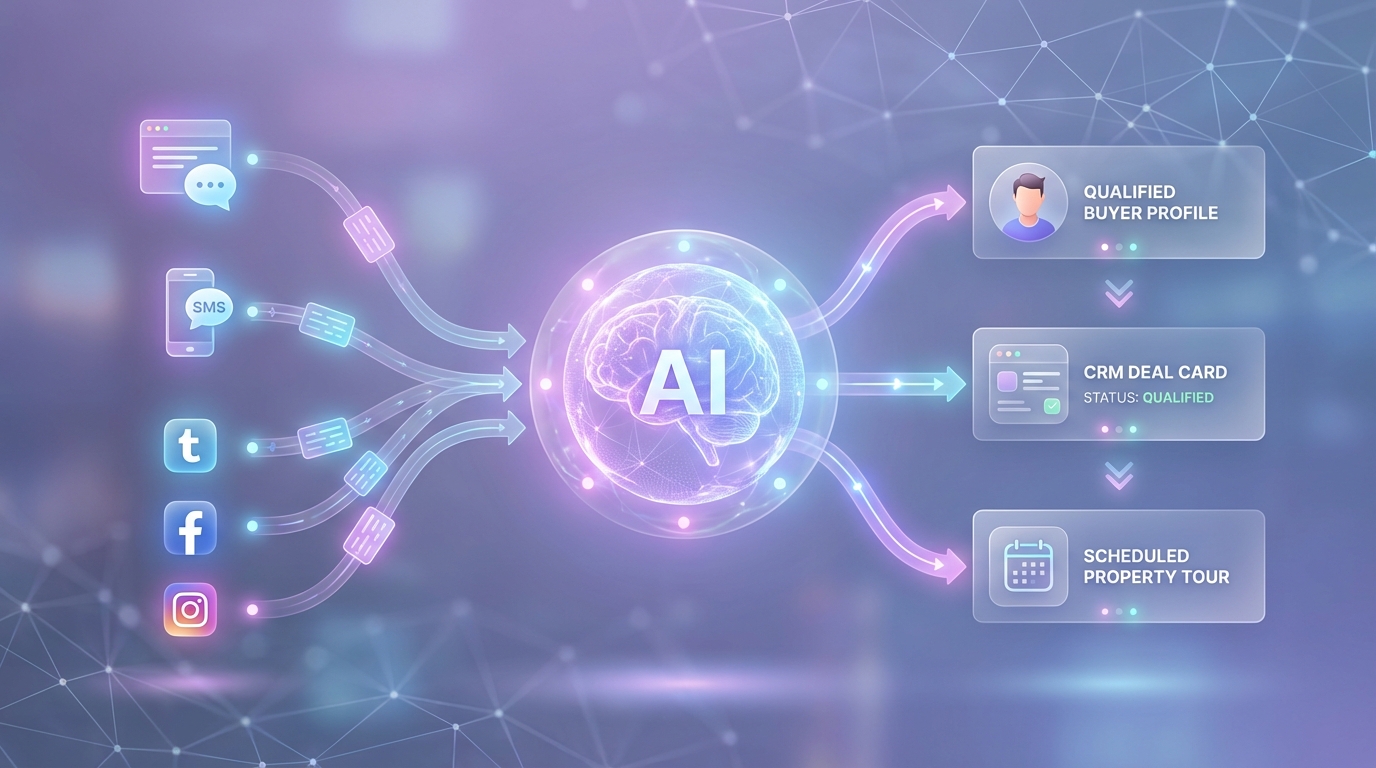 Autonomous AI Funnel
4. Elevating the Human Agent (Not Replacing Them)
A common fear among real estate professionals is that AI will replace the human agent entirely. This is a fundamental misunderstanding of the technology and the psychology of real estate.
Selling a house is not like selling a $20 software subscription. It requires massive emotional intelligence, complex localized negotiations, physical property inspections, and deep psychological reassurance. An AI cannot walk a distressed seller through a tough inspection report. An AI cannot look at a foundation crack and advise on structural integrity. An AI cannot read the room during a multi-offer negotiation.
What the Real Estate AI Assistant does is far more valuable: it completely eliminates the grunt work.
By automating the top of the funnel—the repetitive 50-to-1 follow-ups, the late-night data entry, the basic qualification questions—the AI elevates your human talent. Real estate agents no longer have to spend 60% of their day cold-calling internet leads or doing database re-engagement campaigns. Instead, human agents get to spend 100% of their time actively building relationships, negotiating contracts, and conducting listing presentations.
You are not replacing your agents with AI. You are giving your agents Iron Man suits. You are allowing them to operate at their highest, most profitable capacity while the AI handles the exhausting, high-volume mechanics of lead generation quietly in the background.
5. The Economics Speak for Themselves
The financial argument for deploying a Real Estate AI Assistant is irrefutable. For a highly competitive brokerage, lead generation costs are soaring. It is not uncommon to see a local Cost Per Lead (CPL) hover between $50 and $250 depending on the market and the funnel.
If you are paying $100 for a lead, and you fail to contact them because your human ISA was at dinner, that is $100 destroyed. When you extrapolate that across a marketing budget of $10,000 per month, the leak in the bucket becomes a catastrophic financial failure.
An AI Assistant (like the one implemented via LeadAdvisor AI) operates at a fraction of the cost of a single human employee. It has an SLA (Service Level Agreement) of milliseconds. It never calls in sick, it never drops the ball on an evening weekend lead, and it instantly categorizes every piece of data perfectly into your CRM.
Brokerages that implement intelligent AI assistants routinely see two massive shifts:
- A dramatic decrease in Cost Per Acquisition (CPA), because they are finally converting the night and weekend leads they were previously losing.
- A massive spike in Agent Retention, because agents are suddenly being fed high-volume, pre-qualified, highly motivated appointments on their calendar instead of raw, unverified internet leads.
Conclusion: The Urgency of Adoption in Real Estate
The technology maturity curve in 2026 is brutally unforgiving to laggards. Real Estate AI Assistants are no longer experimental tech reserved for massive national corporate brokerages; they are accessible, highly effective, and easily deployable solutions for independent brokerages and elite teams.
If your real estate website still functions as a passive digital brochure, forcing buyers to fill out "Contact Us" forms or endure simple IF/THEN chatbots, you are hemorrhaging deals every single day to competitors who respond in milliseconds.
The future of real estate is not about generating more leads; it is about converting the leads you already have with absolutely zero friction. It is about deploying tireless, hyper-intelligent software like LeadAdvisor AI to capture demand the exact second it peaks, allowing your elite human agents to do what they do best: close deals.
The shift from manual follow-up to total AI automation is already fully underway. Ensure your brokerage has the tools it needs to outpace the competition.