
AI Customer Success Strategies for 2026: Maximizing Retention
AI Customer Success Strategies for 2026: Maximizing Retention
The B2B software industry is undergoing a massive shift. Acquiring new users is more expensive than ever before. Therefore, the absolute most critical metric for any enterprise software brand in 2026 is Net Revenue Retention. If a company cannot retain its buyers, sustainable growth is mathematically impossible.
Historically, Customer Success teams relied on reactive metrics. An account manager would notice a drop in logins thirty days after the fact, send an email to check in, and hope for a response. By that time, the buyer had already evaluated a competitor and made the decision to churn.
Today, top tier organizations are completely rewriting the playbook. They are deploying advanced Artificial Intelligence not just for sales or support, but strategically across the entire Customer Success lifecycle. By leveraging deeply integrated AI agents, these brands are predicting churn before it happens, automating complex technical onboarding, and scaling personalized health scoring to thousands of accounts simultaneously.
This comprehensive guide breaks down exactly how elite organizations are utilizing algorithmic systems to maximize retention and drive expansion revenue.
1. The Death of Reactive Account Management
The fundamental flaw in traditional Customer Success is bandwidth. A single human manager can effectively build deep relationships with perhaps thirty enterprise accounts. When a company scales, leaders often dilute this ratio, assigning hundreds of accounts to a single representative.
This model breaks down immediately. The human manager cannot possibly monitor the subtle product usage nuances of two hundred different businesses in real time. They resort to sending generic monthly newsletters and hoping for the best.
Artificial Intelligence solves the bandwidth limitation flawlessly. An intelligent CS platform monitors every single account simultaneously. It acts as an omnipresent analyst, tracking terabytes of product telemetry data, Support ticket sentiment, and billing history. When an AI detects a specific anomaly, it can either execute an automated playbook or instantly alert the human manager with a highly synthesized brief.
The role of the human shifts from a data gatherer to a purely strategic consultant. For a look at how this transition mirrors the evolution in outbound pipeline generation, explore our analysis of the Future of AI Sales.
2. Predictive Churn Analysis
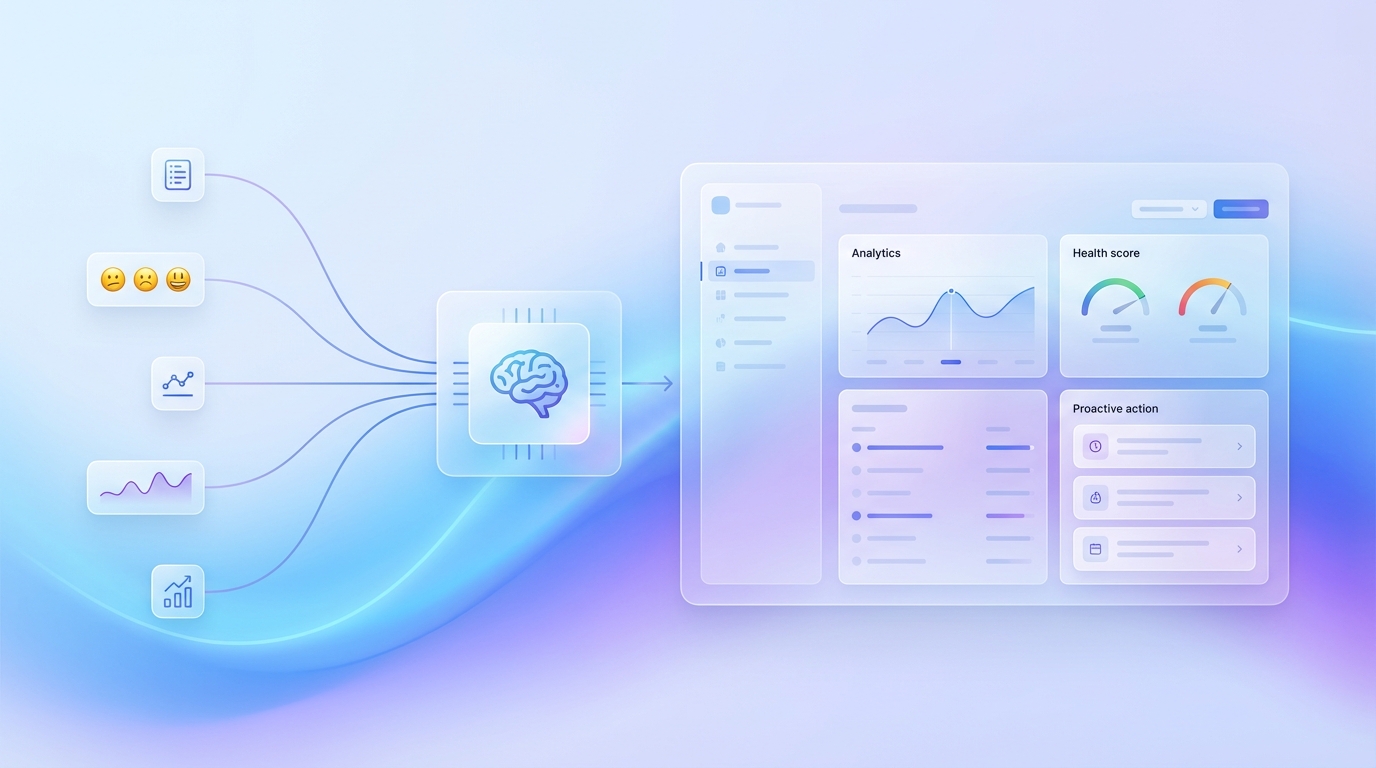 Predictive Churn and Health Scoring
One of the most powerful applications of machine learning in 2026 is the prediction of revenue churn. Modern predictive models do not just look at superficial metrics like the last login date. They map complex multidimensional behavioral patterns.
Identifying the Silent Signals
A user who stops logging in is an obvious churn risk. However, top tier AI models identify the subtle physiological signals of frustration that a human would miss completely.
- The user repeatedly visits the cancellation policy page but does not click the button.
- A champion user leaves the target company, and the new replacement champion logs in less frequently.
- Feature adoption plateaus after four months, indicating the customer has not fully integrated the tool into their core workflow.
When the system detects these hidden patterns, it triggers an immediate retention workflow.
Proactive Intervention
If an AI agent identifies an account with a high churn probability score, it does not wait for a human. It takes action.
The AI might dynamically email the account champion with an invitation to a specialized masterclass on a feature they have been neglecting. If it detects a drop in sentiment via Zendesk tickets, it might automatically generate a task for a Senior Engineer to proactively call the client. This algorithmic intervention has successfully reduced enterprise churn rates by massive margins across the B2B sector.
3. Autonomous Onboarding Workflows
The first ninety days of a B2B SaaS deployment dictate the entire lifecycle of the customer. If the onboarding process is chaotic, slow, or requires too much manual friction, the account will inevitably churn.
AI agents are revolutionizing the implementation phase.
The Dynamic Implementation Roadmap
Historically, onboarding meant a static PDF checklist and a weekly Zoom call. Today, an Agentic AI system creates a dynamic, interactive roadmap tailored to the specific technical maturity of the client.
If the AI notices the client is struggling to configure an API integration, it does not send them a generic link to the documentation. The AI agent initiates an interactive chat session, retrieves the client's specific error logs natively, and proactively supplies the exact JSON payload correction they need to succeed.
This frictionless progression ensures that the customer realizes the value of your product infinitely faster. Time to Value is the ultimate metric of onboarding success, and AI dramatically compresses that timeline. For strategies on automating friction throughout the buyer journey, review How to Automate Support.
4. Intelligent Health Scoring at Scale
Enterprise platforms use health scores to determine which accounts are ripe for upselling and which need immediate triage. The old methodology relied on arbitrary points systems manually configured by operations teams.
Modern AI health scoring is entirely dynamic and predictive. The AI ingests unstructured data from all interconnected platforms to build a holistic picture of the account.
- Email Sentiment: The AI analyzes the tone of emails sent between the vendor and the buyer. Are the buyers expressing excitement or persistent annoyance?
- Contract Utilization: The AI compares the purchased license count against the daily active usage.
- Support Velocity: The AI evaluates how quickly technical issues are resolved for this specific account.
By calculating millions of data points, the algorithm provides an incredibly precise health score. More importantly, it explains the "why." A manager looking at the dashboard does not just see a red score of forty out of one hundred. They see a concise AI generated paragraph explaining that the score dropped because the client has three unresolved critical bugs and their primary administrator recently departed.
5. Driving Expansion and Upsell Revenue
 Expansion Revenue and Retention Growth
While preventing churn is paramount, the true magic of an elite Customer Success organization lies in driving negative net churn through expansion revenue. AI platforms excel at identifying hidden upsell opportunities.
Contextual Cross Selling
Because an AI monitors the exact feature usage of every user, it knows precisely when an account hits the ceiling of their current subscription tier.
If an enterprise client consistently approaches their data storage limit every Tuesday, the AI can trigger a personalized, highly contextual email to the buyer. The message will not be a generic sales pitch. It will highlight the exact operational bottleneck the client is experiencing and mathematically justify the upgrade to a premium tier.
This level of localized relevance drastically increases the conversion rate of expansion campaigns.
Conclusion: The Ultimate Competitive Advantage
The companies that dominate the global B2B landscape in 2026 treat Customer Success not as a cost center, but as their primary engine for sustainable revenue growth.
Failing to implement advanced AI logic into your retention methodology means fighting a modern war with outdated tools. Your competitors will know precisely when their accounts are at risk, while you will rely on guesswork. They will autonomously onboard thousands of users securely, while you scale expensive human headcount just to answer basic implementation questions.
LeadAdvisor AI provides the autonomous intelligence layer required to architect a proactive, elite Customer Success operation. By integrating deeply with your existing infrastructure, our agents understand your data, predict customer behavior, and execute sophisticated retention playbooks instantly.
The future of software is not just about the code you ship. It is about the customer experience you deliver. Elevate your retention strategy and protect your pipeline with the definitive intelligence of Agentic AI.